Health Insurance Marketplace Explained: What It Is and How It Works
By Laurel C. Yazzie | Last reviewed: November 2026
The health insurance marketplace is where millions of Americans who do not get coverage through an employer shop for and buy private health insurance. If you have ever landed on HealthCare.gov feeling unsure about your options, this guide explains exactly how the marketplace works, who it is for, and what to expect when you enroll.
Health Insurance Marketplace Explained: The health insurance marketplace (also called the exchange) is a government-created platform where individuals, families, and small businesses can compare and buy private health insurance plans. Created under the Affordable Care Act, it operates at HealthCare.gov in most states. Subsidies based on income can significantly reduce monthly costs for eligible enrollees.
Having worked directly with clients on marketplace enrollment decisions, the most common misconception I encountered was that the marketplace is only for low-income Americans. In fact, anyone without access to affordable employer-sponsored coverage can use it, and income-based subsidies reach a wider income range than most people expect.
What Is the Health Insurance Marketplace?
The marketplace was created by the Affordable Care Act (ACA) in 2010 and opened for enrollment in 2013. Before it existed, private insurers could deny coverage based on pre-existing conditions and impose lifetime limits on benefits. The marketplace changed that: every plan sold on it must cover a standard set of essential health benefits and apply those protections to every enrollee regardless of health history.
There are two types of marketplaces operating in the U.S.:
- Federal marketplace (HealthCare.gov): Operated by the federal government. As of 2025, 31 states use this platform to offer plans and process enrollment.
- State-based marketplaces: Some states, including California, New York, and Colorado, operate their own separate enrollment website. HealthCare.gov will redirect you to the correct site if your state has its own exchange.
The marketplace is also called the “exchange.” The terms are interchangeable. According to the official HealthCare.gov platform, it provides plan shopping and enrollment services through websites, call centers, and in-person certified assistance.
Who Should Use the Health Insurance Marketplace?
The marketplace is designed for people who do not have coverage through a job, Medicare, Medicaid, or a family member’s employer plan. You must be a U.S. citizen or a lawfully present resident and not currently incarcerated to enroll.
When reviewing policies with clients, the fastest way to cut through the confusion was to start with a simple framework. Use this to decide whether the marketplace is the right path for your situation:
- No employer coverage and income is above Medicaid limits: The marketplace is your primary option.
- Recently lost job-based coverage: A 60-day Special Enrollment Period starts when your prior coverage ends. Act promptly.
- Self-employed or freelancing: The marketplace is your main path to ACA-compliant coverage year-round.
- Have affordable employer coverage: You generally will not qualify for subsidies. Staying on the employer plan is usually the better choice.
- Income at or below 138% of the Federal Poverty Level (in Medicaid expansion states): Apply for Medicaid instead. It is free or very low-cost and has no enrollment window.
- Under age 26: A parent’s employer plan may cost less than any marketplace option available to you.
If you are currently without a job and unsure which coverage route applies to you, our guide on coverage options without an employer covers each path in detail, including Medicaid, COBRA, and marketplace plans side by side.
How the Health Insurance Marketplace Explained Works: Plans, Tiers, and Subsidies
All marketplace plans are required to cover 10 essential health benefits: doctor visits, hospital care, emergency services, preventive care, mental health services, prescription drugs, maternity care, pediatric services, laboratory tests, and rehabilitative services. What varies across plans is how costs are divided between you and the insurer each time you use care.
What Are the Four Metal Tiers?
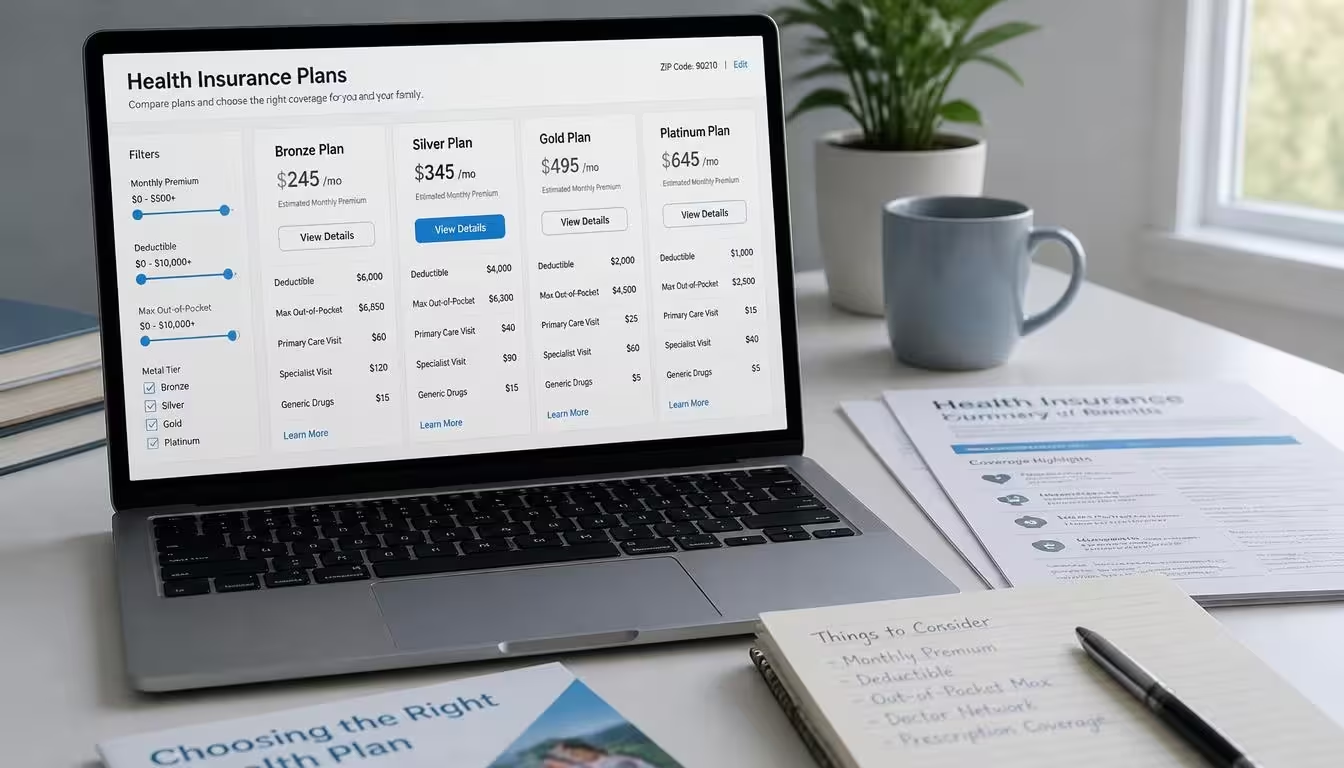
Plans are grouped into four metal tiers based on the average share of costs each party covers. According to the Insurance Information Institute, understanding this split is the key to matching a plan to how often you actually use healthcare.

| Tier | Plan pays (avg.) | You pay (avg.) | Best for |
|---|---|---|---|
| Bronze | ~60% | ~40% | Healthy people who want the lowest monthly premium and rarely need care |
| Silver | ~70% | ~30% | Most shoppers; the only tier that qualifies for Cost-Sharing Reductions |
| Gold | ~80% | ~20% | People who use healthcare regularly throughout the year |
| Platinum | ~90% | ~10% | High healthcare users who can afford a higher monthly premium in exchange for low costs at the point of care |
Silver plans deserve special attention. They are the only tier eligible for Cost-Sharing Reductions (CSRs), which lower your deductible, copays, and out-of-pocket maximum if your income falls between 100% and 250% of the Federal Poverty Level. For many enrollees, a Silver plan with CSRs delivers better total value than a cheaper Bronze plan, even when the monthly premium looks higher at first glance.
What Happens If Your Income Changes During the Year?
This is the part most explanations skip, and it is the detail most likely to create a tax surprise. Premium tax credits are calculated based on the income you estimate when you apply. If your actual annual income turns out to be higher or lower than what you reported, the credit is reconciled when you file your federal tax return for that year.
If you received more credit than you were entitled to, you will owe the difference back to the IRS. If you received less than you were owed, you get the difference as a refund or a reduction in your tax bill. The practical takeaway: report income and household changes to the marketplace throughout the year rather than waiting until tax time. HealthCare.gov allows you to update your application any time your income, household size, or other relevant circumstances change, and keeping your information current prevents a large repayment when you file.
When and How to Enroll in a Marketplace Plan
You can enroll in a marketplace plan during one of two windows. For more detail on the annual timeline, see our guide on when marketplace open enrollment begins.
- Open Enrollment: The annual sign-up period typically runs November 1 through January 15 in most states. Plans selected by December 15 take effect January 1.
- Special Enrollment Period (SEP): Qualifying life events open a 60-day enrollment window outside of Open Enrollment. Common triggers include losing job-based coverage, getting married, having or adopting a child, and moving to a new coverage area.
- Medicaid and CHIP: These programs do not follow the Open Enrollment calendar. You can apply at any time of year if your income qualifies.
To enroll, go to HealthCare.gov or your state’s exchange. You will create an account, enter your household size and estimated annual income, compare available plans by premium, deductible, and network, and complete your enrollment. The site automatically checks whether you qualify for Medicaid or a subsidized marketplace plan based on the information you enter.
Can You Enroll Outside Open Enrollment?
Yes, if you have a qualifying life event. Losing employer-based coverage is the most common trigger. The Special Enrollment Period is generally 60 days from the date of the qualifying event. Missing that window means waiting until the next Open Enrollment period in the fall, so acting promptly after any triggering life change matters.
For a complete overview of health insurance terms, plan types, and decisions, visit our health insurance resource hub.
FAQ: Health Insurance Marketplace Explained
Tap any question to expand the answer.
What is the difference between the health insurance marketplace and HealthCare.gov?
HealthCare.gov is the federal government’s website where you access the health insurance marketplace. The marketplace is the system itself; HealthCare.gov is the platform most states use to run it. Some states operate their own separate exchange websites, such as Covered California or New York State of Health. If your state has its own exchange, HealthCare.gov will detect your location and redirect you to the correct site when you start an application.
Can I use the marketplace if I already have employer-sponsored health insurance?
Technically yes, but you likely will not qualify for subsidies. If your employer offers a plan that meets the ACA’s affordability and minimum value standards, you are generally not eligible for premium tax credits on a marketplace plan. If the employer plan is not considered affordable under ACA rules, you may qualify for marketplace subsidies instead. The HealthCare.gov income estimator tool can help you determine whether your employer coverage disqualifies you from receiving a credit.
How do I know if I qualify for a subsidy on the marketplace?
Eligibility for premium tax credits depends on your household income relative to the Federal Poverty Level, your household size, and whether you have access to affordable employer coverage. Generally, if your income is between 100% and 400% of the Federal Poverty Level, you may qualify for a credit. Enhanced subsidies in recent years extended eligibility to higher income levels as well. The only accurate way to see your specific subsidy amount is to complete an application at HealthCare.gov, which calculates your credit in real time using your actual income, zip code, and household details.
Is marketplace health insurance the same quality as employer coverage?
Yes, marketplace plans must meet the same ACA standards that apply to employer-sponsored plans, including covering all 10 essential health benefits and following rules that cap your annual out-of-pocket costs. The quality of the provider network and the monthly premium will vary by plan and insurer, as with any health insurance. What you will not find on the marketplace is a plan that can deny you coverage due to a pre-existing condition or cancel your coverage because you get sick, both of which the Affordable Care Act prohibits.
What is a Special Enrollment Period and who qualifies for one?
A Special Enrollment Period (SEP) is a window outside of the annual Open Enrollment period during which you can sign up for or change marketplace coverage. It is triggered by qualifying life events such as losing job-based health insurance, getting married, having or adopting a child, moving to a new coverage area, or gaining or losing a dependent. The SEP is generally 60 days from the date of the qualifying event. Missing this window typically means waiting until the next Open Enrollment period in the fall, which is why acting quickly after any major life change is important.