Small Business Loan for Sole Proprietors: What You Need to Know
By Laurel C. Yazzie | Last reviewed: November 2026
Running a business under your own name, without an LLC or corporation, puts you in the same category as millions of American freelancers, independent contractors, and self-employed service providers. Many wonder whether a small business loan for sole proprietors is even possible without a formal business entity behind them. The answer is yes, and understanding how lenders approach the sole proprietor structure makes the process much more manageable.
Having worked directly with clients on loan applications for sole proprietorships and self-employed borrowers, the most common mistake I saw was applying for a large term loan when a business line of credit would have been both easier to qualify for and more practical for how their cash flow actually worked.
Small business loan for sole proprietors: Sole proprietors can qualify for SBA loans, term loans, microloans, and lines of credit just like formally structured businesses. Because there is no legal separation between the owner and the business, lenders place more weight on personal credit history, Schedule C net income, and the borrower’s overall financial picture when evaluating these applications.
What Is a Small Business Loan for Sole Proprietors?
A small business loan for sole proprietors is any financing product that provides capital to a self-employed individual operating under their own name without a formal legal entity such as an LLC or corporation. Lenders do not require a specific business structure to approve financing. What changes is how they evaluate the application: your personal and business finances are reviewed as a single picture rather than as separate legal entities.
This distinction has real practical consequences. See our guide to how small business loans work for the broader mechanics. For sole proprietors specifically, three factors carry extra weight:
- Personal credit score: There is no separate business credit file. Your personal FICO score is the primary credit signal lenders see.
- Personal guarantee: Because you are legally identical to your business, a personal guarantee is not an add-on for sole proprietors. It is built into the structure by default. Your personal assets are at stake if the business cannot repay.
- Schedule C net income: Lenders use the net profit figure from your Schedule C to determine whether your cash flow is sufficient to service the debt.
Best Loan Types Available to Sole Proprietors
Several loan types work well for businesses structured as sole proprietorships. Matching the right loan to your situation improves both your approval odds and the terms you can expect.

SBA 7(a) Loans
The SBA 7(a) program is the most widely used SBA loan and is open to sole proprietors. The U.S. Small Business Administration does not require a specific business entity structure for eligibility. Qualified borrowers can access loan amounts up to $5 million, though most sole proprietors borrow far less. The process takes longer than online lenders, but the terms are generally competitive and repayment periods can extend further than what most alternative lenders offer.
SBA Microloans
SBA microloans are issued through nonprofit intermediary lenders, not banks, with amounts up to $50,000. According to the Small Business Administration, the average microloan is around $13,000. These are particularly useful for newer sole proprietors who need modest capital for equipment, inventory, or working capital and may not yet qualify for a full 7(a) loan. The qualification criteria tend to be more flexible than traditional bank products.
Term Loans and Lines of Credit from Online Lenders
Online lenders tend to have more flexible qualification criteria than traditional banks. Many accept Schedule C income and personal credit in lieu of corporate documents or separate business tax returns. A line of credit is especially practical for sole proprietors managing variable income, since you draw only what you need and pay interest on that amount only. This flexibility makes it a strong fit for service businesses with seasonal or project-based revenue.
Equipment Financing
If you need to purchase business equipment, equipment financing is often one of the more accessible options because the equipment itself typically serves as collateral. This reduces the lender’s risk and can make approval achievable even when personal credit is not perfect. It is a natural fit for tradespeople, photographers, freelancers with studio equipment, or sole proprietors in delivery or transport.
What Lenders Review When You Apply
In practice, many borrowers assume lenders mostly care about how long the business has been open. That matters, but it is only one of several factors. For sole proprietors, the review focuses on the full personal financial picture alongside business performance.
- Personal credit score: Your FICO score is a primary filter. Lenders set their own minimums, which they rarely publish. Checking your rate through a soft-pull prequalification will not affect your score.
- Time in business: Most lenders want to see at least one to two years of operating history. Microloan programs through the SBA are more startup-friendly and may work with shorter track records.
- Revenue and cash flow: Lenders look at whether your business generates enough cash to cover the loan payment comfortably. This is typically evaluated using bank statements and your Schedule C net profit figure.
- Collateral and personal assets: Not every loan requires pledged collateral, but providing it can improve your terms. Because of the personal guarantee, your home, savings, and other personal assets may factor into the lender’s comfort with the loan.
The Schedule C Problem Every Sole Proprietor Should Understand
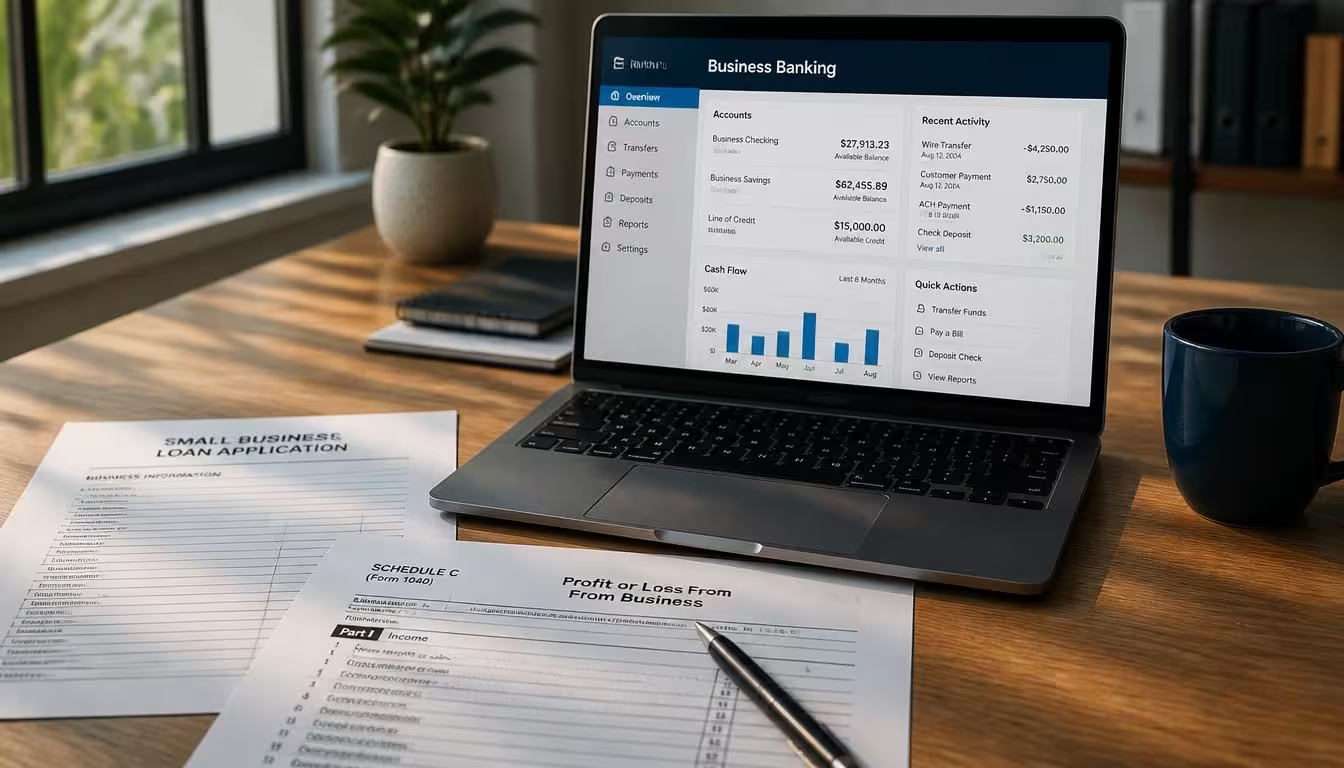
What most people miss when comparing loan offers is a tax-related issue that affects sole proprietors specifically. Your Schedule C, filed as part of your personal Form 1040, reports both your gross business revenue and your deductible business expenses. The net profit figure that results is what most lenders use to calculate your repayment capacity.
The issue: if you have been diligent about claiming legitimate business deductions, your reported net income may be significantly lower than your actual cash flow. A sole proprietor bringing in $90,000 in revenue with $55,000 in expenses reports $35,000 in net profit on Schedule C. Many lenders will base your borrowing limit on that $35,000 figure, not the $90,000 that actually came in.
Some lenders, particularly online lenders, evaluate 12 months of business bank statements alongside or instead of Schedule C. If your deductions have reduced your net income substantially, seek out lenders that include a bank statement review in their underwriting process. It is worth asking about this directly before you apply, rather than discovering it after a denial.
Documents You Will Need to Apply
Being organized before you apply speeds up the process and reduces the chance of a denial based on incomplete information. The exact list varies by lender, but most sole proprietors should prepare the following.
- Personal tax returns with Schedule C for the past one to two years
- Personal bank statements for the past three to six months
- Business bank statements for the past three to six months (if you maintain a separate business account, which is strongly advisable)
- Government-issued photo ID
- Business license or DBA registration, if applicable in your state
- Proof of business address such as a utility bill, lease agreement, or similar document
- A simple business plan or use-of-funds statement for SBA loans and larger bank loans — a one-page summary of what you need the money for and how you plan to repay it
How to Improve Your Approval Odds
A few practical steps can meaningfully improve how lenders view your application before you submit it.
- Open a dedicated business checking account if you have not already. Commingling personal and business funds makes it harder for lenders to verify your business revenue cleanly.
- Check your personal credit report for errors at AnnualCreditReport.com, the only federally authorized source for free annual credit reports. Errors on your report can lower your score and affect your loan terms.
- Keep two or more years of consistent income documentation. Lenders favor applicants who can show steady or growing revenue over time rather than a single strong year surrounded by gaps.
- Be transparent about your business structure. Sole proprietors are eligible for most loan programs, so there is no benefit in obscuring your structure.
The Federal Trade Commission recommends that small business borrowers review loan agreements carefully before signing, paying particular attention to the annual percentage rate, prepayment penalties, and any personal guarantee clauses. For sole proprietors, the personal guarantee deserves extra attention because your personal assets, not just business assets, are on the line.
The follow-up question most sole proprietors have after understanding their loan options is how exactly their personal credit score affects the terms they receive. Because sole proprietorships have no separate business credit file, your personal score influences not just approval but also your interest rate and borrowing limit. For a full look at this dynamic, see our guide on how personal credit affects business loans.
For a full overview of your financing options as a small business owner, visit our small business loan options hub.
Frequently Asked Questions
Can a sole proprietor get a business loan without forming an LLC?
Yes. Sole proprietors are eligible for most small business loan programs, including SBA loans. Lenders do not require a formal legal entity structure to approve financing. The key difference is that your personal finances and business finances are reviewed together, since there is no legal separation between you and your business. Many sole proprietors successfully obtain term loans, lines of credit, and SBA microloans each year.
What documents does a sole proprietor need to apply for a business loan?
Most lenders ask for personal and business bank statements from the past three to six months, along with personal tax returns that include Schedule C for the past one to two years. You will also typically need a government-issued photo ID and, for SBA or bank loans, a brief description of how you plan to use the funds. Having a dedicated business checking account makes this documentation process considerably easier and can improve your approval odds. Some lenders also request a business license or DBA registration if applicable.
How does a sole proprietor prove income when applying for a business loan?
Sole proprietors prove income primarily through Form 1040 with Schedule C, which reports net profit from the business. Lenders use this net figure to calculate whether you have sufficient cash flow to service the loan. Some online lenders also accept business bank statements as an alternative or supplement, which can be helpful if your Schedule C net income is lower than your actual cash flow due to business deductions. Keeping clean, separate business banking records strengthens your application significantly.
Are interest rates higher for sole proprietors than for LLC borrowers?
Lenders set their own rate criteria and rarely publish specific requirements, so there is no universal rule that sole proprietors pay higher rates. What matters most is your personal credit score, your documented income, and the type of loan you are applying for. A sole proprietor with strong credit and consistent revenue can often access rates comparable to what an LLC borrower would receive for the same loan type. The Federal Reserve publishes average consumer and commercial credit rates at federalreserve.gov, which can help you benchmark any offer you receive.
Can a sole proprietor qualify for an SBA loan?
Yes. The U.S. Small Business Administration does not exclude sole proprietors from any of its major loan programs. The SBA 7(a) program, SBA Express, and the SBA microloan program are all available to businesses structured as sole proprietorships, provided you meet the eligibility criteria. The microloan program, which offers loans up to $50,000 through nonprofit intermediary lenders, is often the most accessible starting point for sole proprietors who are newer to borrowing. Find details and find an approved lender at sba.gov.
Frequently Asked Questions
Tap any question to expand the answer.
Can a sole proprietor get a business loan without forming an LLC?
Yes. Sole proprietors are eligible for most small business loan programs, including SBA loans. Lenders do not require a formal legal entity structure to approve financing. The key difference is that your personal finances and business finances are reviewed together, since there is no legal separation between you and your business. Many sole proprietors successfully obtain term loans, lines of credit, and SBA microloans each year.
What documents does a sole proprietor need to apply for a business loan?
Most lenders ask for personal and business bank statements from the past three to six months, along with personal tax returns that include Schedule C for the past one to two years. You will also typically need a government-issued photo ID and, for SBA or bank loans, a brief description of how you plan to use the funds. Having a dedicated business checking account makes this documentation process considerably easier and can improve your approval odds. Some lenders also request a business license or DBA registration if applicable.
How does a sole proprietor prove income when applying for a business loan?
Sole proprietors prove income primarily through Form 1040 with Schedule C, which reports net profit from the business. Lenders use this net figure to calculate whether you have sufficient cash flow to service the loan. Some online lenders also accept business bank statements as an alternative or supplement, which can be helpful if your Schedule C net income is lower than your actual cash flow due to business deductions. Keeping clean, separate business banking records strengthens your application significantly.
Are interest rates higher for sole proprietors than for LLC borrowers?
Lenders set their own rate criteria and rarely publish specific requirements, so there is no universal rule that sole proprietors pay higher rates. What matters most is your personal credit score, your documented income, and the type of loan you are applying for. A sole proprietor with strong credit and consistent revenue can often access rates comparable to what an LLC borrower would receive for the same loan type. The Federal Reserve publishes average consumer and commercial credit rates at federalreserve.gov, which can help you benchmark any offer you receive.
Can a sole proprietor qualify for an SBA loan?
Yes. The U.S. Small Business Administration does not exclude sole proprietors from any of its major loan programs. The SBA 7(a) program, SBA Express, and the SBA microloan program are all available to businesses structured as sole proprietorships, provided you meet the eligibility criteria. The microloan program, which offers loans up to $50,000 through nonprofit intermediary lenders, is often the most accessible starting point for sole proprietors who are newer to borrowing. Find details and find an approved lender at sba.gov.