How to Compare Personal Loan Lenders: A Practical Guide
By Laurel C. Yazzie | Last reviewed: November 2026
Shopping for a personal loan without a comparison strategy is like buying a car by visiting only one dealership. You might get a decent deal, but you will never know whether you left a better one on the table. Knowing how to compare personal loan lenders the right way can save you hundreds or even thousands of dollars over the life of your loan.
In reviewing hundreds of loan applications over a decade in consumer lending, the detail most borrowers miss is treating each lender’s offer as if it were the only one, without putting them side by side under identical terms. That single habit leads to overpaying more often than any other mistake in the borrowing process.
This guide walks you through exactly what to look at, what to watch out for, and how to gather real offers without damaging your credit score.
What to Look at When You Compare Personal Loan Lenders
The Consumer Financial Protection Bureau recommends shopping with more than one lender before committing to any personal loan offer. Before you request quotes, decide on a specific loan amount and repayment term and use those same numbers with every lender you approach. This consistency is the foundation of any useful comparison. Without it, you are comparing apples to oranges rather than evaluating which lender is actually giving you a better deal.
Here are the key factors to evaluate across every offer you receive:
- Annual Percentage Rate (APR): The single most important number. APR includes both the interest rate and any origination fee rolled into the annual cost, so it reflects what the loan actually costs you each year rather than just the base interest charge.
- Origination and other fees: Some lenders charge an upfront origination fee; others charge nothing. Late fees, non-sufficient funds fees, and prepayment penalties vary as well and are worth reading carefully in any loan agreement.
- Loan amount range: Confirm the lender will approve the specific amount you need. Some lenders cap loans at a lower figure than their advertised maximum.
- Repayment terms available: Longer terms lower your monthly payment but increase the total interest paid over time. Shorter terms cost less overall but require higher monthly payments each month.
- Prequalification process: Does the lender allow a soft credit pull to show you a rate estimate before a full application? This protects your credit score while you shop.
- Hardship and flexibility options: Can you move your payment date if your payday changes? Does the lender offer a pause option if you face an unexpected financial setback?
- Lender type: Banks, online lenders, and credit unions each operate differently. They have different eligibility standards, funding speeds, and rate structures worth understanding before you apply.
Understanding what goes into your quoted rate before you shop helps you approach each lender with realistic expectations. For a full breakdown, see our article on factors that shape your rate.
How APR and Fees Reveal the True Cost
The interest rate alone is not enough to compare two loan offers accurately. The APR tells you more because it folds in the origination fee, if the lender charges one. A lender with a slightly higher interest rate but no origination fee can easily be cheaper overall than a lender with a lower rate but a large origination fee deducted from your funds before you receive them. Always look at APR first, not just the interest rate percentage.

Beyond the APR, check for these fees when reviewing any loan agreement:
- Origination fee: Charged upfront, often deducted from your loan proceeds before the funds are sent to you. Not all lenders charge this fee.
- Late payment fee: Charged if your payment arrives after the due date. Some lenders offer a grace period; others apply the fee immediately.
- Non-sufficient funds (NSF) fee: Charged if a scheduled payment is returned because your bank account lacks enough funds to cover it.
- Prepayment penalty: Rare with personal loans, but worth verifying. This fee applies if you pay off the loan ahead of schedule.
The Federal Reserve’s G.19 consumer credit release tracks average interest rates on personal loans. Reviewing those figures gives you a real benchmark for evaluating whether a quoted rate is competitive for your credit profile, rather than relying only on the advertised rates that apply to the most creditworthy borrowers.
If you are unsure whether a fixed or variable rate makes more sense for your situation, review our guide on choosing between fixed and variable rates before accepting any offer.
Banks, Online Lenders, and Credit Unions: How They Compare
Not all lenders operate the same way, and the type of institution you borrow from affects the rate you are offered, how quickly you receive funds, and what happens if you run into difficulty during repayment. Most personal loans are unsecured, meaning no collateral is required, but lender standards and service models still vary significantly across institution types.
| Lender Type | Best For | Funding Speed | Membership Required | Key Drawback |
|---|---|---|---|---|
| Bank | Existing customers; larger loan amounts | Varies; often several business days | No | Stricter credit requirements; slower process |
| Online Lender | Speed; easy side-by-side comparison | Often 1 to 3 business days | No | No in-person support or branch access |
| Credit Union | Competitive rates; flexible eligibility criteria | Varies by institution | Yes | Must meet membership requirements before applying |
Which Type of Lender Fits Your Situation?
What most people miss when comparing loan offers is that the right lender type depends on their financial profile, not just the advertised rate. Use this framework to narrow your starting point:
- If you have an existing banking relationship: Start with your bank. Many banks offer loyalty rate discounts to customers who already hold a checking or savings account with them, which can offset a higher posted rate.
- If you need money quickly: Online lenders typically process and fund loans faster than traditional banks or credit unions. Funding timelines vary by lender, so confirm before you apply.
- If your credit is fair or you want the most flexible terms: Credit unions are member-owned nonprofits, which means they often offer lower rates and more personalized service. Eligibility criteria can also be more flexible than at large commercial banks.
- If you want to compare multiple real offers at once: Apply to several online lenders in a focused window. Rate-shopping within a short period limits the cumulative impact on your credit score.
How to Compare Personal Loan Lenders Without Hurting Your Credit Score
Every time a lender runs a hard inquiry on your credit report, your credit score can dip slightly. The good news is that most personal loan lenders allow you to check your rate first through a soft credit pull, commonly called prequalification. This soft inquiry does not affect your credit score and gives you a realistic rate estimate based on your actual income and credit profile before you commit to a full application.
Here is how to use prequalification as a comparison tool:
- Gather your basic financial information: estimated annual income, employment status, monthly housing payment, and a rough sense of your credit score range.
- Go to the websites of at least three different lenders and complete their prequalification forms. Each form typically takes a few minutes and requires no hard inquiry.
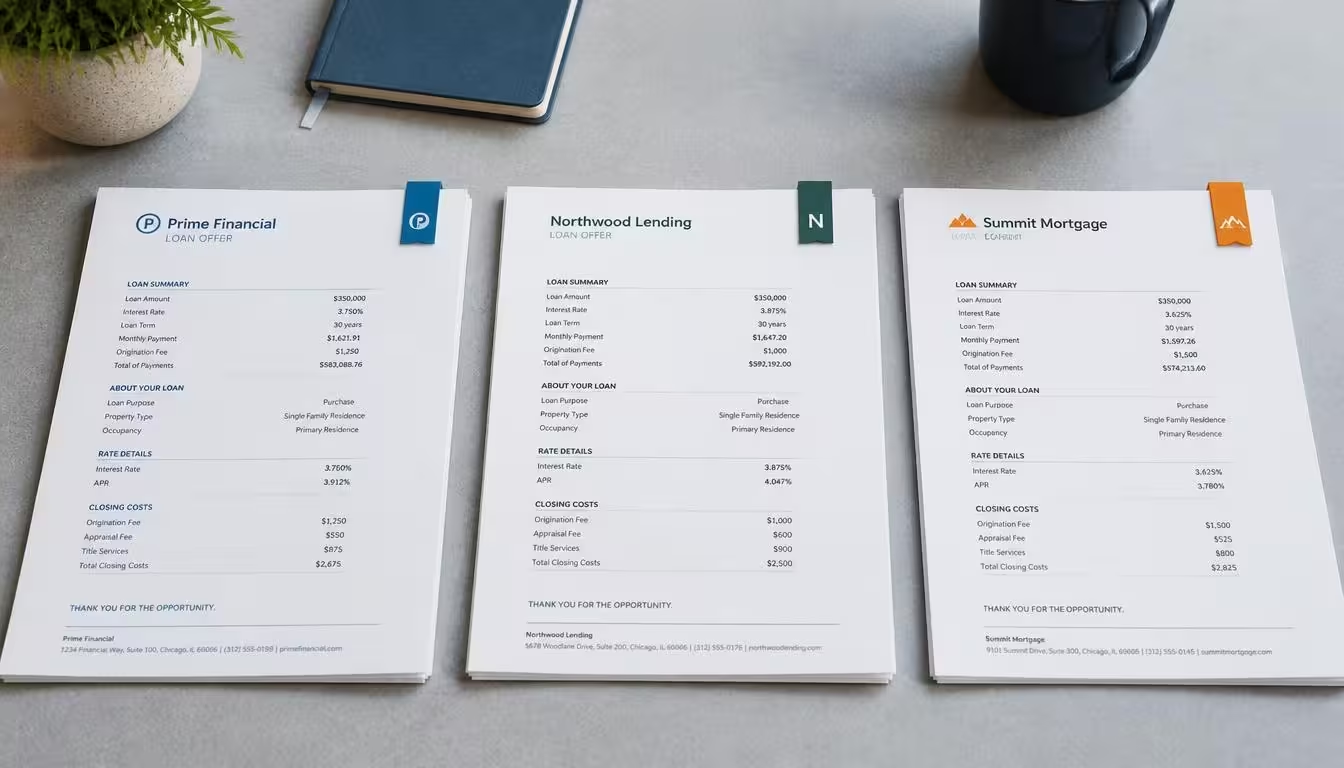
- Compare the offers you receive side by side: the APR, the loan amount approved, the repayment term offered, and any fees listed in the offer summary.
- Once you identify the strongest offer, submit a full application to that lender only. This is when the hard inquiry occurs, but it happens only once.
Prequalification does not guarantee final approval or lock in the quoted rate. The rate can change once the lender verifies your income and credit during the full underwriting review. Still, it gives you a far more accurate picture than any advertised rate ever will.
What If Two Offers Look Almost Identical?
If you are comparing two offers with nearly the same APR, look at lender flexibility and secondary fees. Can either lender let you shift your payment date if your payday changes? Does one charge a non-sufficient funds fee and the other does not? Small differences in flexibility and fees outside the APR are often what separate a smooth borrowing experience from a stressful one when life does not go according to plan.
Red Flags to Watch For When Comparing Lenders
Not every lender that advertises personal loans operates legitimately. From a practical standpoint, some red flags are obvious only once you know what to look for. Keep these warning signs in mind during your comparison process:
- Guaranteed approval claims: Legitimate lenders always review your credit and income before approving a loan. Any lender that promises approval before seeing your application is a warning sign.
- Upfront payment required before funding: Real lenders do not ask you to pay a fee before releasing your loan proceeds. This is a hallmark of advance-fee fraud.
- No physical address or licensing information: Verify that any lender is licensed to operate in your state. The Consumer Financial Protection Bureau’s personal loans resource explains how to evaluate lender legitimacy before you apply.
- Pressure to accept immediately: A lender that tells you an offer expires within hours is using a pressure tactic. Legitimate personal loan offers give you time to review the terms and compare them to other options.
- APR not clearly disclosed: Any lender that is vague about APR or buries fees in footnotes is making it harder for you to compare accurately on purpose. That evasiveness is worth noting before you go any further.
For a broader overview of personal loan options, including how to build a full borrowing strategy, visit our full personal loans guide.
Loan Offer Comparison Calculator
Enter the same loan amount for both offers, then adjust the APR and repayment term for each. The calculator shows which offer costs less overall.
Offer 1
Offer 2
This calculator estimates principal-and-interest costs only. It does not include origination fees or other charges outside the APR.