Personal Loan Origination Fee Explained: What It Costs and How to Handle It
By Laurel C. Yazzie | Last reviewed: May 2026
When you apply for a personal loan, the interest rate gets most of the attention. But there is another charge that can quietly shrink the amount of money you actually receive on funding day: the origination fee. Knowing how it works before you sign can prevent real surprises.
In reviewing hundreds of loan applications over a decade in consumer lending, the detail most borrowers miss is that the origination fee reduces what you actually receive, not what you agreed to borrow. That distinction matters a great deal if you need a specific amount of cash for a purpose like a home repair or a medical expense.
Personal Loan Origination Fee: A personal loan origination fee is a one-time upfront charge a lender deducts from your loan proceeds to cover the cost of processing your application. It reduces the cash you actually receive. Comparing the full annual percentage rate (APR), which folds this fee in, is the most reliable way to compare loan offers.
What Is a Personal Loan Origination Fee?
A personal loan origination fee is a one-time charge a lender collects to cover the administrative costs of processing, underwriting, and funding your loan. It is separate from the interest rate, though it is folded into the annual percentage rate (APR) that lenders are required to disclose under federal law.
According to the Consumer Financial Protection Bureau, comparing the APR rather than just the stated interest rate is the most accurate way to measure the true cost of a loan, because the APR captures fees like this one in a single number.
Lenders use several names for this fee. Knowing the aliases helps you spot it in loan paperwork before you sign:
- Origination fee (most common term)
- Administrative fee
- Processing fee
- Underwriting fee
- Sign-up fee or funding fee
The fee is generally nonrefundable once the loan is funded. If you accept a loan offer and then change your mind, ask your lender directly whether the fee is refundable and at what point in the process the cancellation window closes.
How a Personal Loan Origination Fee Is Calculated
Most origination fees are charged as a percentage of the total loan amount, though some lenders use a flat dollar fee instead. Because the percentage-based method ties the fee to the loan size, borrowing a larger amount means paying a larger fee in absolute dollar terms.
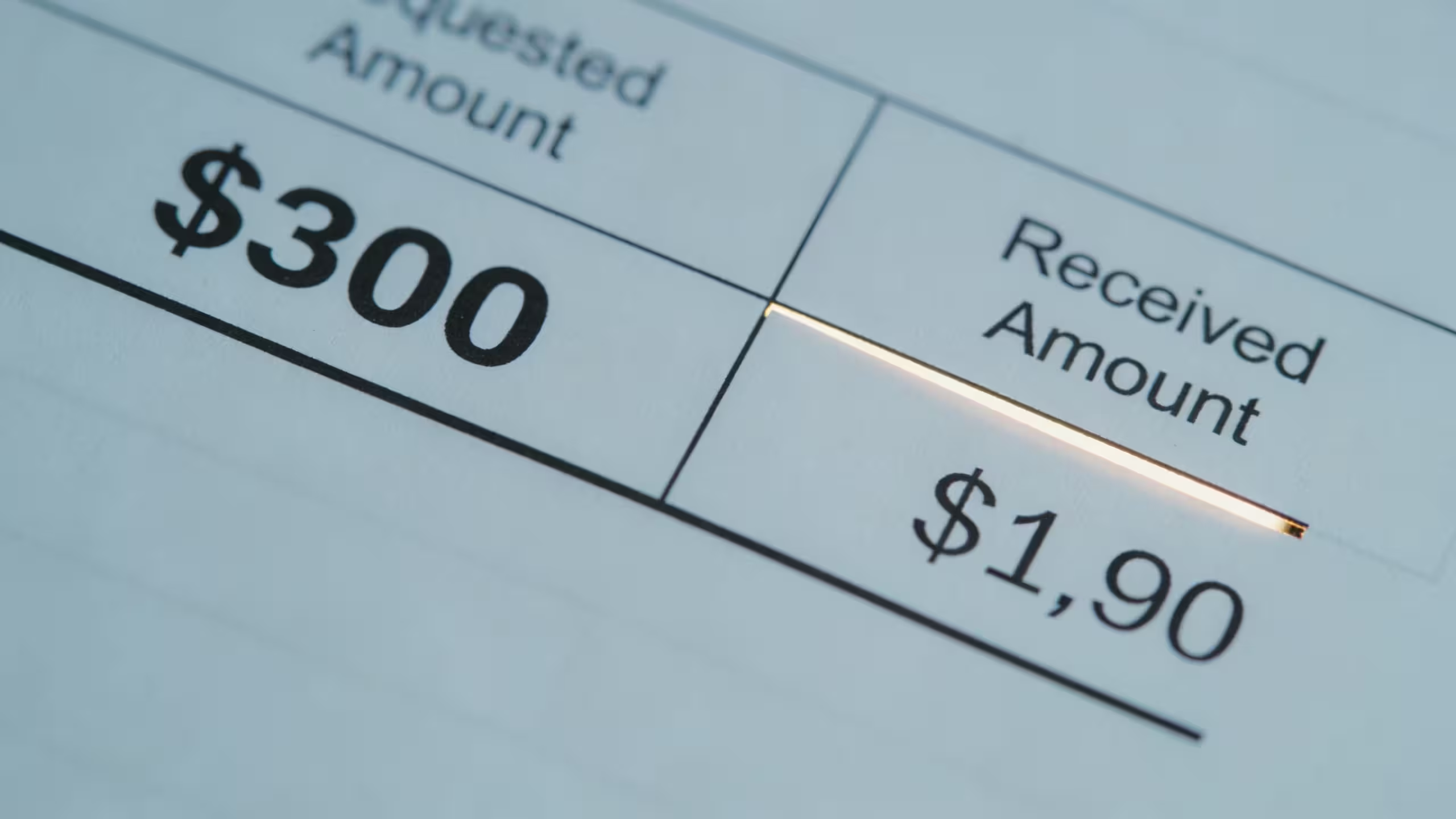
Here is an illustrative example that shows how the math works. Assume a borrower requests a $10,000 personal loan and their lender charges a 5% origination fee:
| Item | Amount |
|---|---|
| Loan requested | $10,000 |
| Origination fee (5%) | $500 |
| Cash you receive | $9,500 |
| Total you repay (before interest) | $10,000 |
You received $9,500. You still owe $10,000. That $500 gap is the origination fee working in the lender’s favor.
What Happens to the Fee When the Loan Is Funded?
Lenders handle the origination fee in one of two ways. The method your lender uses affects how much cash arrives in your account on funding day, so it is worth confirming this before you accept an offer.
- Deducted from proceeds: The lender holds back the fee amount and deposits only the remainder into your account. This is the more common approach. You receive less than you requested but repay the full loan amount.
- Added to the loan balance: The fee is rolled into your total debt. You receive the full requested amount, but you now owe the original principal plus the fee, and you pay interest on that combined balance for the life of the loan.
Neither method eliminates the cost. The method only changes when and how you feel it.
What If You Need a Specific Dollar Amount After the Fee Is Deducted?
This is a problem in practice that most loan guides skip entirely. Suppose you need exactly $10,000 in hand for a specific expense, but your lender deducts a 5% origination fee from your proceeds. If you request $10,000, you will receive only $9,500. That is $500 short of what you need.
To receive a target amount after an origination fee is deducted, use this formula:
Amount to request = Amount you need ÷ (1 − fee as a decimal)
Example: You need $10,000 and the fee is 5%.
$10,000 ÷ (1 − 0.05) = $10,000 ÷ 0.95 = approximately $10,527
Requesting $10,527 means the lender deducts about $527 and deposits $10,000 into your account.
Ask your lender to confirm exactly how the fee is applied and whether rounding rules apply before submitting your final application.
What Determines How Much You Pay?
The origination fee is not a fixed charge set by a government body. Each lender sets its own fee structure, and the percentage you are quoted depends on factors specific to you and the loan you are requesting.
- Credit score: Borrowers with higher credit scores typically qualify for lower fees or no fee at all. Lenders set their own minimum credit score requirements, which they rarely publish publicly. Checking your rate with multiple lenders through a soft-pull pre-qualification will not affect your score.
- Debt-to-income ratio (DTI): A lower DTI signals less financial strain, which can reduce the fee a lender charges.
- Loan amount: Some lenders charge a lower percentage on larger loans, because the fixed cost of processing is spread across more dollars.
- Loan term: Longer repayment terms extend the lender’s risk, which can result in a higher fee.
- Lender policy: Some lenders charge no origination fee at all, regardless of borrower profile. This is a business decision, not a government rule.
What most people miss when comparing loan offers is that the origination fee percentage can vary significantly from one lender to another for the exact same borrower profile. The Federal Trade Commission advises consumers to request complete fee disclosures in writing before agreeing to any loan terms, so you can compare the full cost of each offer side by side.
To understand how all the pieces of a personal loan, including fees, interest, and loan term, fit together, see our overview of how personal loans work.
Origination Fee or No-Fee Loan: Which Costs Less?
A loan with no origination fee sounds like the obvious winner. But that is not always the case. Lenders that waive the origination fee frequently offset it with a higher interest rate. Over a full loan term, the extra interest can cost more than the fee would have.
From a practical standpoint, the only reliable comparison point is the APR, not the interest rate or the fee in isolation. The APR combines both into a single annualized percentage.
Decision Framework: Fee Loan vs. No-Fee Loan
If you plan to carry the loan to its full term: Compare APRs directly. The lower APR wins, fee or no fee.
If you plan to pay off the loan early: A no-fee loan usually costs less. You will not have had enough time in repayment for the lower interest rate to make up for the fee you already paid.
If two loans show the same APR: Choose the no-fee loan. Fewer charges mean less complexity, and no gap between what you borrow and what you actually receive.
The Consumer Financial Protection Bureau provides guidance on evaluating loan costs, including APR, on its personal loans resource page. Using that framework before accepting any offer puts you in a stronger position.
Does a Fee Change How Much Interest You Pay?
Yes, indirectly. If the origination fee is added to your loan balance rather than deducted from your proceeds, you pay interest on the fee amount for the entire loan term. On a longer loan, this can meaningfully increase the total cost. This is one more reason to confirm the fee method with your lender upfront and to use the APR as your primary comparison tool.
How to Reduce or Avoid a Personal Loan Origination Fee
You have more options than most borrowers realize. Some lenders are flexible on fees, and others eliminate them entirely for well-qualified applicants. The strategies below can help reduce what you pay.
- Strengthen your credit before applying: Lenders typically reserve their lowest fees for borrowers with strong credit histories. Even a modest score improvement can shift which fee tier you qualify for.
- Compare at least three lenders: Fee policies differ significantly from lender to lender for the same loan amount and term. Comparing offers is the most direct way to lower your cost.
- Ask about fee waivers: Some lenders will reduce or waive the origination fee for well-qualified borrowers who ask. It is worth requesting this before accepting a final offer.
- Consider credit unions: Federal credit unions are member-owned nonprofits. They often charge lower fees than banks or online lenders on personal loans.
- Review all line items in the loan disclosure: Origination fees sometimes appear under different names. Read every charge listed, not just the headline interest rate.
- Watch for upfront fee requests: A legitimate lender deducts fees from your loan proceeds or adds them to your balance. Be cautious of any lender that asks you to pay a fee out of pocket before funds are disbursed. The FTC flags this as a warning sign of loan scams.
If your credit score is limiting your options and increasing the fees lenders are quoting, our guide on getting a personal loan with bad credit covers strategies that can improve your position. For a broader view of personal loan products and how to compare them, visit our personal loan resource center.
FAQ: Personal Loan Origination Fees
Is an origination fee the same as an application fee?
No, these are two different charges. An application fee is sometimes charged when you submit a loan request, before the lender makes any approval decision. An origination fee, by contrast, is charged after you are approved and is tied to the processing and funding of the loan itself. Not all lenders charge either fee, and some charge both. Always ask for a complete list of fees before submitting a formal application so you can compare total costs across lenders.
Can I negotiate an origination fee?
Yes, some lenders will reduce or waive an origination fee for borrowers with strong credit or stable income, particularly if you are bringing in a substantial loan amount. The key is to ask before accepting the offer, not after. Online lenders and large banks tend to have more rigid fee structures, while credit unions and community banks may have more flexibility. If a lender refuses to negotiate on the fee, that is useful information: it signals that shopping other lenders is likely worth your time.
Does the origination fee affect my credit score?
The origination fee itself does not directly affect your credit score. However, the loan that carries it does. When a personal loan is opened, it typically triggers a hard inquiry on your credit report, which can cause a small, temporary score decrease. The loan balance also affects your credit utilization and debt load. Paying the loan on time every month has a positive long-term effect on your credit history, which can more than offset the initial inquiry over time.
Is a personal loan origination fee tax-deductible?
For most personal loans used for personal expenses, origination fees are not tax-deductible. The IRS generally does not allow deductions for interest or fees on personal loans used for non-business purposes. However, if the loan proceeds are used exclusively for a business purpose and you are self-employed, a portion of the fees may qualify as a business expense. Tax rules in this area can be complex, so consult a qualified tax professional before claiming any deduction related to personal loan fees.
If I refinance my personal loan, do I pay the origination fee again?
Yes. Refinancing means taking out a new loan to pay off the old one, and the new lender will apply its own fee structure to the new loan. If the new lender charges an origination fee, you will pay it on the refinanced amount, just as you did on the original loan. This is an important cost to factor into your refinancing math. The interest savings from a lower rate need to outweigh the new origination fee for the refinance to make financial sense. Use the APR on both loans as your primary comparison.