How Student Loan Interest Works: A 2025-2026 Guide
By Laurel C. Yazzie | Last reviewed: July 2026
When you take out a student loan, you agree to repay more than you borrowed. The extra amount is interest. Understanding how that interest builds, when it gets added to your balance, and how to keep it under control can save you thousands of dollars over the life of your loan.
In reviewing hundreds of loan applications over a decade in consumer lending, the detail most borrowers miss is how quickly daily interest grows when it is not paid before a capitalization event. That single oversight often adds thousands to a borrower’s final balance.
How student loan interest works: Student loan interest is the cost of borrowing money for education. Interest accrues daily on your remaining principal balance, calculated using your annual interest rate divided by 365. Payments go to fees first, then interest, then principal. On unsubsidized loans, interest begins accruing from the day funds are disbursed, even while you are in school.
To understand how student loans are structured from the start, see our guide on how federal student loans are structured.
How Student Loan Interest Works: The Daily Formula
Federal student loans use a simple daily interest formula. Interest does not compound daily on its own, but it does accrue every single day on your remaining principal balance.
The formula is:
Daily interest = Principal balance x (Annual interest rate / 365)
Using a loan of $10,000 at the 2025-2026 undergraduate rate of 6.39%, the author’s calculation yields approximately $1.75 in interest per day. Over a standard four-year enrollment period (roughly 1,460 days), unpaid interest reaches approximately $2,555. That calculation is the author’s own derivation from the rate published by Federal Student Aid. If this interest is not paid before repayment begins and capitalizes, the borrower starts repayment on a principal of roughly $12,555 rather than $10,000.
Subsidized vs. Unsubsidized: Who Pays the Interest During School?
The type of federal loan you hold determines whether the government or you is responsible for interest during enrollment and the grace period.
| Feature | Direct Subsidized Loan | Direct Unsubsidized Loan |
|---|---|---|
| Who pays interest during school (half-time+)? | U.S. Department of Education | You (accrues immediately on disbursement) |
| Who pays during 6-month grace period? | U.S. Department of Education | You |
| Who pays during qualifying deferment? | U.S. Department of Education | You |
| Available to | Undergraduates with demonstrated financial need | Undergraduate, graduate, and professional students |
| Interest rate (2025–2026, fixed) | 6.39% | 6.39% (undergraduate) / 7.94% (graduate) |
According to the Consumer Financial Protection Bureau, the government also pays interest on subsidized loans during deferment triggered by economic hardship, unemployment, cancer treatment, or military deployment. For both loan types, however, you are responsible for interest that accrues during a forbearance.
What Is Interest Capitalization?
Capitalization is what happens when unpaid accrued interest is added to your principal balance. After that point, your daily interest calculation runs on the new, larger total. You begin paying interest on interest.
Capitalization does not happen automatically every month. It occurs at specific trigger points:
| Trigger | Applies to |
|---|---|
| Grace period ends and repayment begins | Unsubsidized loans (if interest was not paid during school) |
| Exit from deferment on an unsubsidized loan | Direct Loans, unsubsidized |
| Leaving income-based repayment (IBR) after no longer qualifying | Direct Loans on IBR |
| Consolidation into a Direct Consolidation Loan | All loans being consolidated |
What Happens to Capitalized Interest When You Consolidate?
This is the capitalization trigger most borrowers do not anticipate. When you combine multiple federal loans into a single Direct Consolidation Loan, any unpaid interest on each individual loan is added to your new principal at the moment of consolidation.
A borrower with three unsubsidized loans totaling $30,000 in principal and $2,000 in unpaid accrued interest, for example, would begin the consolidated loan at a starting balance of approximately $32,000. The new daily interest calculation runs on that higher figure for the remaining repayment term. The CFPB specifically recommends paying off outstanding interest before consolidating whenever the budget allows, because that step prevents the accrued interest from becoming part of the balance you are charged interest on going forward. Current consolidation guidance is available at consumerfinance.gov/paying-for-college.
Federal Student Loan Interest Rates for 2025-2026
Federal rates are set by Congress each spring, based on the high yield of the 10-year Treasury note auctioned before June 1. The rates below apply to Direct Loans disbursed between July 1, 2025 and June 30, 2026, per the official announcement from Federal Student Aid. Once set, the rate on each loan is fixed for that loan’s lifetime.
| Loan Type | Borrower | Fixed Rate (2025-2026) |
|---|---|---|
| Direct Subsidized / Unsubsidized | Undergraduate students | 6.39% |
| Direct Unsubsidized | Graduate and professional students | 7.94% |
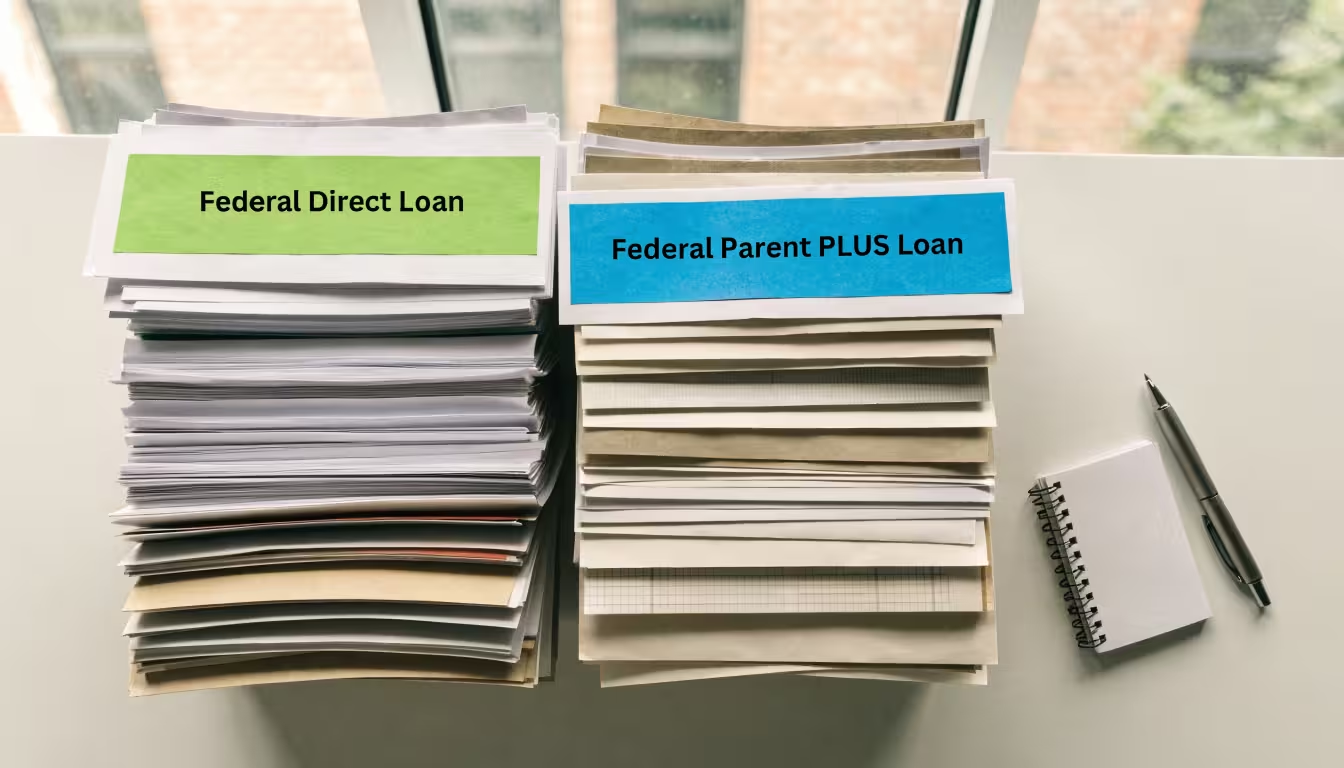
| Direct PLUS | Parents of dependent undergraduates and graduate-professional students | 8.94% |
Note: Beginning July 1, 2026, graduate and professional students enrolling in a new course of study are no longer eligible for the Graduate PLUS loan, per recent federal legislation. Check studentaid.gov for current loan availability and terms.
Should You Pay Interest While Still in School?
This is the single most practical question a student borrower can ask. The answer depends on your loan type and your budget.
Decision framework:
- If you have a subsidized loan: The Department of Education covers interest during enrollment, the grace period, and qualifying deferments. You do not need to pay interest during school.
- If you have an unsubsidized loan and can afford any amount: Even a small monthly payment toward interest during school reduces what will capitalize at graduation. Use the daily formula above to calculate your daily accrual, then try to cover at least that much each month.
- If your budget allows nothing extra during school: Prioritize paying off all accrued interest before your grace period ends. That is the capitalization trigger you can most directly control. A lump-sum payment before your first billing date can prevent a permanent balance increase.
What most people miss when comparing loan offers is the payment waterfall. According to the Consumer Financial Protection Bureau, when you make a payment, it is applied to any outstanding fees first, then to accrued interest, and then to your principal balance. In the early months of repayment, a substantial share of each payment goes to interest rather than reducing the amount owed. Extra payments directed to principal shorten the repayment term and reduce total interest. Tell your servicer in writing to apply any overpayment to your highest-rate loan’s principal.
Falling behind has serious consequences beyond interest. Our article on the consequences of missing a payment explains the day-by-day timeline from delinquency to default.
How to Reduce the Total Interest You Pay
These strategies work whether you are still in school or already in repayment.
- Enroll in autopay. The U.S. Department of Education announced a 1% interest rate reduction for Direct Loan borrowers enrolled in automatic payment, available through June 30, 2028 for those who enroll by September 30, 2026. See the full announcement at ed.gov and verify current eligibility before enrolling.
- Direct extra payments to principal. Once accrued interest is covered, any additional amount goes to principal. Ask your servicer in writing to apply the surplus to your highest-rate loan first.
- Choose the right repayment plan. As of July 1, 2026, two new federal plans are available: the Repayment Assistance Plan (RAP), an income-driven option designed so that full, on-time payments always make progress toward reducing principal; and the Tiered Standard plan, which offers fixed terms of 10, 15, 20, or 25 years based on total debt. The SAVE plan is no longer available. Borrowers previously on SAVE must select a new plan. Use the Loan Simulator at studentaid.gov to compare options by monthly payment and total interest.
- Pay off accrued interest before any pause ends. Whether ending a deferment, a forbearance, or consolidating, paying down outstanding interest before the event prevents it from capitalizing and permanently increasing your principal.
- Avoid extending your repayment term unnecessarily. A longer term lowers the monthly payment but increases the total interest paid over the life of the loan. Run both scenarios through the Loan Simulator before deciding.
For a complete overview of student loan types, borrowing limits, and repayment strategies, visit our student loans resource center.
FAQ: How Student Loan Interest Works
Tap any question to expand the answer.
Does student loan interest compound daily?
Federal student loans use a simple interest formula, not compound interest. Interest accrues each day on your remaining principal balance but is not automatically added to that balance daily. Compounding occurs only when unpaid interest capitalizes at specific trigger points, such as when your grace period ends or when you exit deferment. Until capitalization happens, daily interest sits as a separate accrued amount alongside your principal.
When does student loan interest start accruing?
For Direct Unsubsidized Loans, interest begins accruing on the day your loan funds are disbursed to your school, even if you are still enrolled full-time. For Direct Subsidized Loans, the U.S. Department of Education pays the interest while you are enrolled at least half-time, during the six-month grace period after you leave school, and during qualifying deferments. Once repayment begins on a subsidized loan, you become responsible for all interest from that point forward.
Can you deduct student loan interest on your taxes?
You may be able to deduct up to $2,500 of the student loan interest you paid in a given tax year, depending on your income and filing status, according to the Consumer Financial Protection Bureau. This deduction applies to both federal and qualifying private student loans. Income limits apply and phase out at higher income levels, so the deduction may be reduced or unavailable depending on your adjusted gross income. Consult a tax professional or visit IRS.gov for the current income thresholds and form instructions.
What is the difference between deferment and forbearance for interest?
Both deferment and forbearance are temporary pauses on required monthly payments, but they differ in how interest is handled. During qualifying deferment on a subsidized loan, the Department of Education pays your interest so your balance does not grow. During forbearance, you are responsible for all interest on both subsidized and unsubsidized loans, and that interest may capitalize when the forbearance ends. For this reason, income-driven repayment is generally a better long-term option than forbearance when you cannot afford your payments.
Why does my loan balance barely go down even though I make payments every month?
This happens because of the payment waterfall. When you make a monthly payment, it is applied to any outstanding fees first, then to accrued interest, and only then to your principal balance. Early in repayment, with a large outstanding balance, the accrued interest portion of each payment is relatively high, leaving little to apply toward the principal. Making extra payments and asking your servicer in writing to apply them to principal first is the most effective way to accelerate progress and reduce the total interest paid over the life of the loan.