Why Payday Loans Are Expensive: The Real Cost Breakdown
By Laurel C. Yazzie | Last reviewed: June 2026
Payday loans look simple on the surface. You borrow a few hundred dollars, pay a fee, and pay it back on your next payday. But the actual cost of that fee is far higher than most borrowers realize, and it is the reason why payday loans are expensive compared to nearly every other form of credit available in the United States.
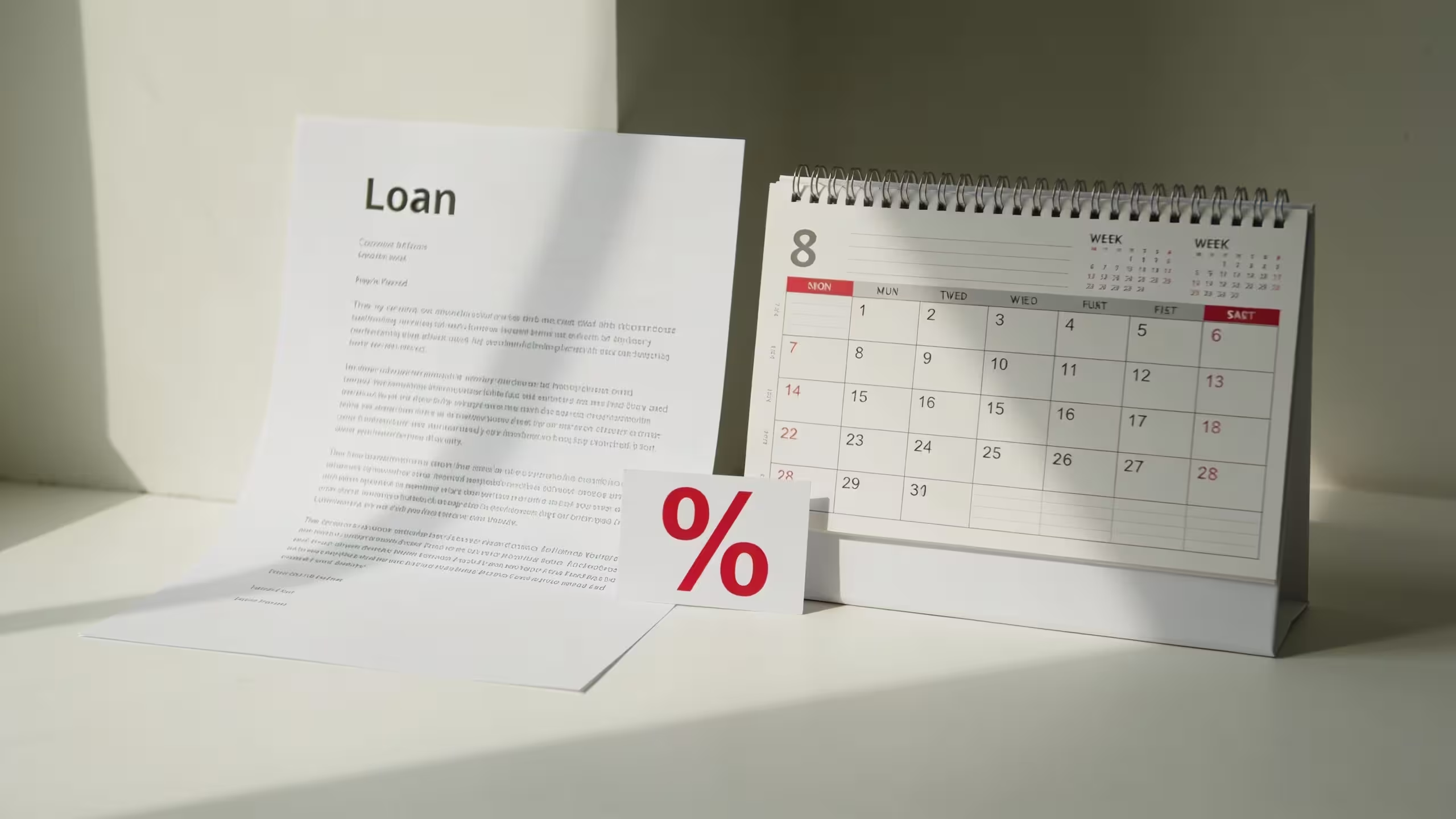
Why payday loans are expensive: Payday lenders charge a flat fee, typically $15 per $100 borrowed, which converts to an annual percentage rate of nearly 400% for a two-week loan. That fee structure, combined with short repayment terms and frequent rollovers, makes payday loans one of the most costly ways to borrow money in the United States.
In reviewing hundreds of loan applications over a decade in consumer lending, the detail most borrowers miss is that they are not comparing the APR of a payday loan to other forms of credit before they sign. This guide breaks down the cost mechanics step by step so you can make an informed decision.
Why Payday Loans Are Expensive: The Core Reason
The root cause is simple: payday lenders charge a flat fee rather than a traditional interest rate, and that flat fee converts to an extremely high annual percentage rate because of the short loan term. According to the Consumer Financial Protection Bureau (CFPB), the finance charge on a payday loan typically ranges from $10 to $30 for every $100 borrowed, with $15 per $100 being the most common amount.
That might sound modest. A $15 charge on a $100 loan looks like 15%. But it is not a 15% annual rate. The loan is due in two weeks, and when you convert that two-week fee into an annual rate, the math changes dramatically.
- The fee is charged upfront, not spread over months like a standard loan.
- The loan term is two weeks, not a year.
- Lenders price the fee as a flat cost, which hides how large the annualized rate really is.
- The short term means you lose any benefit of spreading the cost over time.
How a $15 Fee Becomes a 400% Annual Rate
Under the federal Truth in Lending Act, payday lenders are required to disclose the APR in writing before you sign. According to the Consumer Financial Protection Bureau, a $15 fee on a two-week $100 loan equates to an APR of almost 400 percent. Here is why that happens:
- A year contains 26 two-week periods.
- If you paid that $15 fee on a $100 balance every two weeks for a full year, you would pay $390 in fees on a $100 loan.
- That works out to a 390% annualized cost, which rounds to the “nearly 400%” figure the CFPB cites.
- So on a $300 loan: $45 fee due in two weeks, total repayment $345, equivalent APR approximately 400%.
The fee itself does not change. The short repayment window is what inflates the annual rate. Most borrowers focus on the flat dollar amount and never see the annualized number until after they have signed.
How Fees Add Up Every Time You Roll Over
The flat fee is only part of the story. The cost multiplies when a borrower cannot repay the full balance on the due date. In that situation, many lenders allow a rollover: you pay the current fee again, and your due date extends by two more weeks. Each rollover restarts the fee clock without reducing your principal by a single dollar.
In practice, many borrowers roll the same loan over multiple times. According to the Consumer Financial Protection Bureau, payday borrowers continue to pay significant rollover fees despite state-level protections. On a $300 loan with a $15-per-$100 fee, each rollover costs $45 and does not reduce your principal at all.
The Real Cost of Five Rollovers on a $300 Loan
Consider a borrower who takes out a $300 payday loan with a $45 fee, cannot repay on payday, and rolls the loan over five times before they can pay it off in full. Here is exactly what that costs:
- Original loan: borrow $300, pay $45 fee at signing
- Rollover 1: pay $45 fee, due date moves two weeks, still owe $300
- Rollover 2: pay $45 fee, due date moves two weeks, still owe $300
- Rollover 3: pay $45 fee, due date moves two weeks, still owe $300
- Rollover 4: pay $45 fee, due date moves two weeks, still owe $300
- Rollover 5: pay $45 fee, due date moves two weeks, still owe $300
- Final repayment: pay $300 principal only — the rollover fee already covered this final period
Total paid: $570 to borrow $300 for roughly three months. Fees alone totaled $270.
Other Costs That Make Payday Loans Even Pricier
The per-$100 finance charge is not always the only cost you face. State laws and individual lender policies can layer additional charges on top of the base fee. What most people miss when comparing loan offers is that these add-on costs can push the total well beyond the disclosed finance charge.
- Returned payment fee: If your bank account does not have enough funds when the lender tries to collect, both the lender and your bank may charge a separate fee.
- Late fees: Some lenders charge a penalty if you do not repay by the due date and have not arranged an extension.
- Prepaid card fees: If your loan funds are loaded onto a prepaid debit card, some lenders charge an additional card- loading or activation fee.
- Repeated debit attempts: The CFPB has documented cases where lenders make multiple electronic withdrawal attempts on a single debt, triggering a new bank fee on every failed attempt.
Always ask the lender for the full list of possible fees before you sign. Federal law requires them to disclose all fees and the APR in writing before you agree to the loan.
How Payday Loan Costs Compare to Other Borrowing Options
Payday loans are not the only way to cover a short-term cash gap. A comparison shows just how much more expensive they are relative to other options. Note: interest rate ranges for credit cards and personal loans vary by creditworthiness and lender. For current benchmark rates on consumer credit, the Federal Reserve publishes average consumer credit rates at federalreserve.gov.
| Borrowing Option | Typical Term | Cost Structure | APR (Approximate) |
|---|---|---|---|
| Payday loan | 2 weeks | Flat fee per $100 | ~400% (CFPB) |
| Credit union PAL (Payday Alternative Loan) | 1–6 months | Capped interest rate | Capped at 28% by federal regulation |
| Credit card cash advance | Flexible | Interest on balance | See Federal Reserve G.19 |
| Personal loan (bank or credit union) | Months to years | Fixed monthly installments | See Federal Reserve G.19 |
| Employer paycheck advance | Until next payday | Often no fee (employer-paid) | 0% if fee-free |
Federally regulated credit unions offer Payday Alternative Loans with an APR capped at 28% by federal regulation. That is roughly one-fourteenth the cost of a typical payday loan. If you are eligible to join a credit union, this is the closest like-for-like substitute.
What Is Better Than a Payday Loan?
The short answer: almost any other option carries a lower cost. A credit union PAL, a small personal loan, a paycheck advance from your employer, a cash advance on a credit card, or even a payment plan negotiated directly with a creditor will almost always cost less than a payday loan. For a complete breakdown of what is available to you, see our guide to alternatives to payday loans and explore the full overview at the payday loans hub page.
What to Do If You Are Already in the Payday Loan Cycle
Getting out of the rollover cycle is difficult but possible. A few concrete steps can help you stop the fee accumulation and start reducing the balance you owe.
- Ask about a no-cost extended payment plan: Many states require lenders to offer at least one free extended repayment plan to borrowers who cannot pay. Most lenders do not advertise this option, so ask the lender directly before you agree to another rollover fee.
- Contact a nonprofit credit counselor: The Federal Trade Commission recommends working with a nonprofit credit counseling agency certified by the National Foundation for Credit Counseling if you are struggling with payday debt.
- Check your state’s rules: Some states ban rollovers altogether or cap how many times a lender can extend a loan. Your state’s financial regulator can tell you what rights you have as a borrower.
- Look into payday loan consolidation: Some credit unions and nonprofit lenders offer small loans specifically designed to help borrowers pay off payday loan debt at a lower rate.
To understand the full process from application through repayment, including what happens if you cannot pay and how lenders are allowed to collect, see our guide on how payday loans work.
FAQ: Why Are Payday Loans So Expensive?
Why do payday loan fees translate to such a high APR?
The APR on a payday loan is high because the loan term is very short. A $15 fee on a $100 two-week loan looks small in dollar terms, but the annual percentage rate calculation spreads that cost across a full year. Because a year contains 26 two-week periods, that single $15 fee converts to an APR of nearly 400%, according to the Consumer Financial Protection Bureau. The fee amount does not change; the short repayment window is what inflates the annualized rate so dramatically.
Does rolling over a payday loan always cost the same fee?
Yes. In most cases, each rollover costs the same flat fee as the original loan. On a $300 loan with a $15-per-$100 fee, every rollover costs $45 and does not reduce your principal by a single dollar. It only extends your due date by two more weeks. This means the longer you stay in the loan, the more you pay in total fees relative to the amount you originally borrowed, without making any progress on the balance owed.
Are payday loan fees the same in every state?
No. State laws govern the maximum fee a payday lender can charge, so what you pay depends heavily on where you live. The Consumer Financial Protection Bureau notes that finance charges range from $10 to $30 per $100 borrowed depending on state law. Some states ban payday lending altogether. Others cap fees at specific levels or restrict the number of rollovers a lender can offer. Your state’s financial regulator is the most reliable source for the rules that apply to you.
Can a payday lender legally charge me more than the disclosed fee?
Under the federal Truth in Lending Act, payday lenders are required to disclose all fees and the APR in writing before you sign the loan agreement. If you are charged fees that were not disclosed beforehand, the lender may have violated federal law. You can file a complaint with the Consumer Financial Protection Bureau at consumerfinance.gov or by calling (855) 411-2372. You can also contact your state attorney general’s office for state-level enforcement options.
What is the cheapest way to borrow a small amount in an emergency?
Federally regulated credit union Payday Alternative Loans (PALs) are among the lowest-cost borrowing options, with APRs capped at 28% by federal regulation. Employer paycheck advances, if your workplace offers them, are often free. Nonprofit emergency assistance programs in your community may provide help with no interest charge at all. The Federal Trade Commission recommends exploring all of these options before turning to a payday lender, since nearly every alternative carries a lower total cost.