How Payday Loans Work: A Plain-Language Breakdown
By Laurel C. Yazzie | Last reviewed: June 2026
If you have ever been short on cash before payday and wondered whether a payday loan could help, you are not alone. Millions of Americans consider this option every year. Before you sign anything, though, it pays to understand exactly how payday loans work, what they cost, and what you are agreeing to when you walk out with that cash.
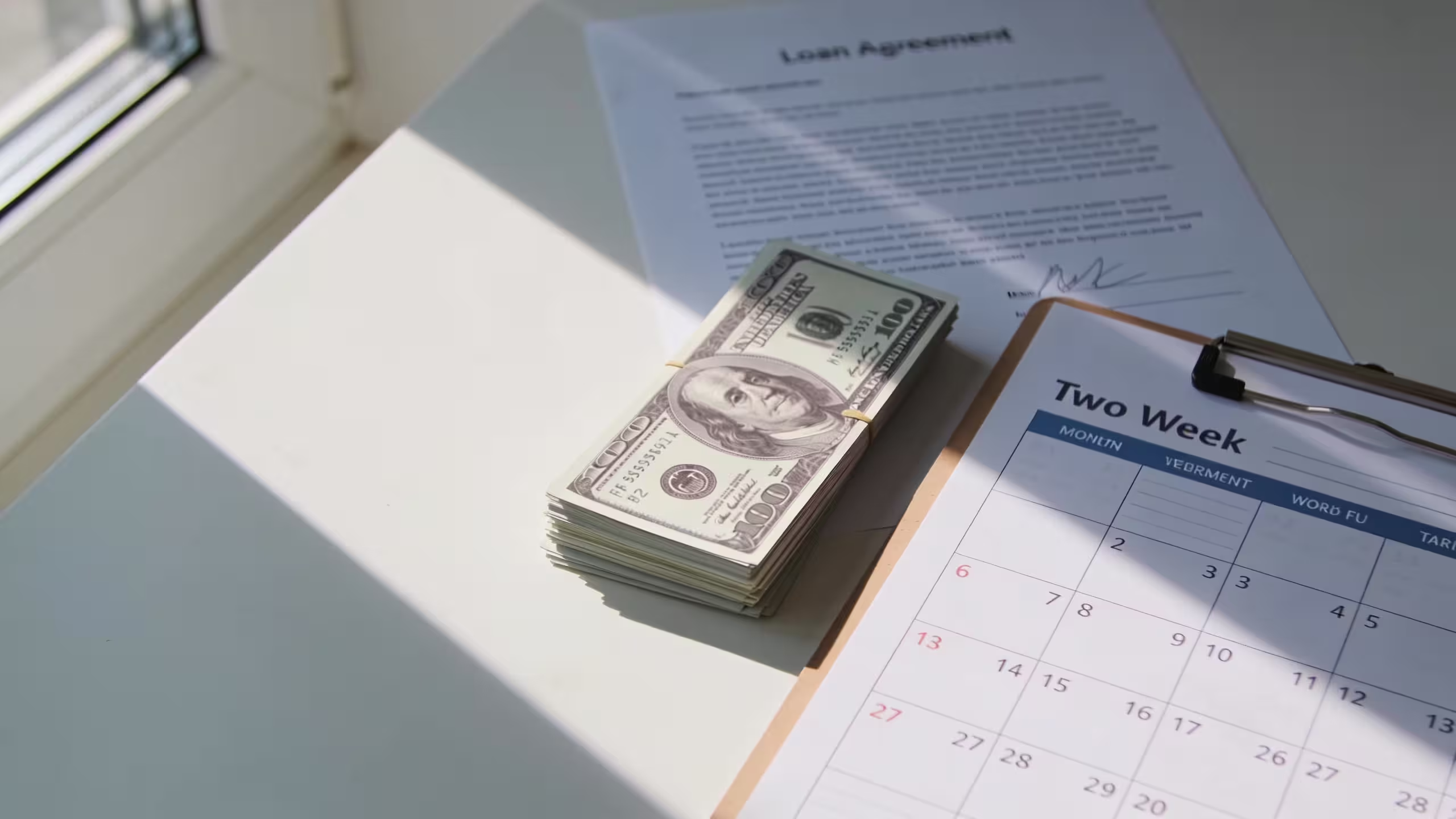
How Payday Loans Work: A payday loan is a short-term loan, typically for $500 or less, that you repay in a single payment on your next payday. You receive cash quickly, often the same day, in exchange for a fee. The lender takes a post-dated check or electronic access to your bank account to collect repayment.
What Is a Payday Loan?
A payday loan is a small-dollar, short-term loan designed to bridge the gap between paychecks. Unlike a personal loan from a bank, it does not require a credit check, and approval can happen in minutes. That speed is part of its appeal, but it also comes with serious trade-offs.
In reviewing hundreds of loan applications over a decade in consumer lending, the detail most borrowers miss is the true cost of a payday loan compared to other short-term options available to them.
- Unsecured: No collateral required to borrow
- Short term: Typically due within 14 days or by your next payday
- Small amounts: Most loans cap at $500, though limits vary by state
- No credit check: Lenders verify income and a bank account, not your credit history
- High cost: Fees translate to very high annual percentage rates (APRs)
How Payday Loans Work: A Step-by-Step Breakdown
The process for getting a payday loan is simple by design. Lenders keep the barriers low to attract borrowers quickly. Here is how the typical transaction unfolds from application to repayment.
- Apply: You visit a storefront lender or apply online. You provide a government-issued ID, proof of income such as a pay stub or bank statement, and an active checking account number.
- Get approved: The lender confirms you meet their basic requirements. Most approvals take minutes, not days.
- Sign the agreement: You receive and sign a loan agreement that states the loan amount, the fee charged, and the exact repayment due date.
- Authorize repayment: You either write a post-dated check for the full repayment amount or sign an electronic authorization allowing the lender to debit your bank account on the due date.
- Receive your funds: Depending on the lender, you get cash at the storefront, a check, or a direct deposit to your bank account. Some online lenders fund the loan the next business day.
- Repayment is collected automatically: On your next payday, the lender processes your check or bank debit. If the full amount clears, the loan is closed.
What You Need to Apply
Requirements differ by lender and state, but most payday lenders ask for the same basics. You do not need a strong credit history. You do need a steady income and an active bank account.
- Government-issued photo ID
- Proof of income (pay stub, benefit statement, or recent bank statement)
- Active checking account
- Social Security number (required by most lenders)
- Minimum age of 18
How Much Does a Payday Loan Actually Cost?
The cost of a payday loan is expressed as a flat fee rather than an interest rate. That framing makes it easy to underestimate the real expense. According to the Consumer Financial Protection Bureau (CFPB), payday loan fees typically run $10 to $30 for every $100 borrowed. A $15 fee on a $100 two-week loan works out to an APR of roughly 391%, which is the number that puts payday loan costs in proper perspective against other forms of credit.
| Borrowing Option | Typical Cost Basis | Repayment Structure |
|---|---|---|
| Payday loan | Fee per $100 borrowed (see CFPB for current data) | Lump sum on next payday |
| Credit card cash advance | Cash advance fee plus your card’s APR (check your cardholder agreement) | Minimum monthly payments |
| Credit union payday alternative loan (PAL) | Lower APR; NCUA caps fees on federally chartered credit union PALs | Installments over 1 to 6 months |
| Personal loan (bank or online lender) | APR based on creditworthiness (Federal Reserve publishes average consumer credit rates) | Fixed monthly installments |
What Happens When You Cannot Repay on Time
This is the part most articles skip over, and it is the most consequential part of how payday loans work. If your account does not have enough funds on the due date, two things can happen: the lender processes the payment anyway, which can trigger a bank overdraft fee on top of the loan fee, or the lender offers you a rollover.
A rollover lets you extend the loan by paying only the fee now and pushing the principal to your next payday. It sounds like relief, but it restarts the fee cycle without reducing what you owe. The CFPB has documented that more than four out of five payday loans are re-borrowed within a month, and nearly one in four initial payday loans are re-borrowed nine times or more, with borrowers ultimately paying far more in fees than they ever received in credit.
What most people miss when comparing loan offers is that the rollover trap is not a worst-case scenario. For many borrowers, it is the typical outcome. For a deeper look at the fee math behind this cycle, see our article on why payday loans are so expensive.
Payday Loan Regulations You Should Know
Payday loans are regulated at the state level, and the rules vary widely. Some states cap fees, limit rollovers, or restrict loan amounts. Others have banned payday lending entirely. Before you apply, confirm that payday loans are legal in your state.
- Not available everywhere: Several states prohibit payday loans, including New York, New Jersey, Pennsylvania, and Massachusetts, among others. Availability depends entirely on where you live.
- New federal payment protections (effective March 30, 2025): Under the CFPB’s updated rule, after two failed attempts to withdraw payment from your bank account, a payday lender cannot try again unless you specifically authorize another attempt. This prevents a pile-up of overdraft fees from repeated failed debits.
- Watch for scams: The Federal Trade Commission (FTC) warns consumers about illegal payday lending operations that ignore state law, charge unlicensed fees, or threaten borrowers over the phone. Licensed lenders are required to disclose all fees and terms before you sign.
Should You Take a Payday Loan? A Simple Decision Framework
Payday loans are not always the wrong choice. But they are rarely the right first choice. Before you apply, run through this three-part check.
A payday loan may be worth considering only if all three of these are true:
- The expense is a genuine emergency, not a discretionary purchase
- You are certain your next paycheck will cover the full loan amount plus the fee, without leaving you short for the following two weeks
- You have already confirmed that a credit union payday alternative loan, a payment plan with the creditor, or an employer pay advance is not available to you
If any of those is not true, the risk of rolling over the loan is high, and the total cost will likely exceed the original emergency amount.
In practice, many borrowers take out a payday loan expecting it to be a one-time fix, only to find that repaying the full balance on a single paycheck leaves them short again for the next two weeks, and the cycle starts over.
If you want options that cost less and carry less risk, our guide on payday loan alternatives covers several practical paths you may not have considered. The full payday loans hub gives you a complete side-by-side overview of every option in this cluster.
FAQ: How Payday Loans Work
How long do you have to repay a payday loan?
Most payday loans are due in full on your next payday, which is typically 14 days from the date you borrow. Some states allow loan terms as long as 30 days, and a small number permit installment-style payday loans that spread repayment over several pay periods. The exact due date is set by the lender at the time you sign the agreement, so always confirm the specific date before you leave.
Do payday loans affect your credit score?
Most payday lenders do not report on-time repayments to the major credit bureaus, so paying your loan back as agreed typically will not help your credit score. However, if your loan goes to a collection agency after a default, that collection account can appear on your credit report and damage your score. Some lenders also use ChexSystems or similar services rather than traditional credit bureaus when approving borrowers.
What happens if a payday lender tries to take money and my account is empty?
If the lender attempts to debit your account and the funds are not there, your bank will likely charge you a non-sufficient funds (NSF) fee, which typically runs $25 to $35 per failed transaction. As of March 30, 2025, a new CFPB rule limits payday lenders to two failed withdrawal attempts before they must get your explicit written authorization to try again. This prevents lenders from repeatedly hitting an empty account and stacking up NSF fees on your side.
Are payday loans legal in every state?
No. Several states have banned payday loans entirely or imposed interest rate caps so low that payday lenders do not operate there. States including New York, New Jersey, Pennsylvania, Massachusetts, and Vermont are among those where traditional payday loans are not available to consumers. Before applying with any lender, confirm that payday lending is permitted under your state’s law, since some online lenders may attempt to offer loans to residents of states that prohibit them.
Can you get a payday loan without a bank account?
Some storefront lenders will issue a payday loan and give you the funds as cash or on a prepaid debit card, without requiring a traditional bank account. However, these options are less common and vary by state and lender. Most online payday lenders require a bank account because they use electronic fund transfers for both disbursement and repayment. If you do not have a checking account, ask the lender directly what disbursement and repayment options they offer before submitting your application.