How Much Would a $5,000 Personal Loan Cost Monthly?
By Laurel C. Yazzie | Last reviewed: May 2026
Knowing how much a $5,000 personal loan will cost each month is one of the most practical questions to ask before you apply. The answer is not a fixed number. It depends on two things: the annual percentage rate (APR) your lender offers and the repayment term you choose.
Both variables pull your payment in opposite directions. A lower APR or a longer term shrinks your monthly bill. A higher APR or a shorter term raises it. Understanding how they interact gives you real control over what you commit to each month.
How Much Would a $5,000 Personal Loan Cost Monthly: It depends on your APR and loan term. At a 12% APR over 24 months, you would pay roughly $235 per month. Over 60 months, the same rate drops your payment to about $111. A higher APR means a higher payment at any term length.
How Much Would a $5,000 Personal Loan Cost Monthly?
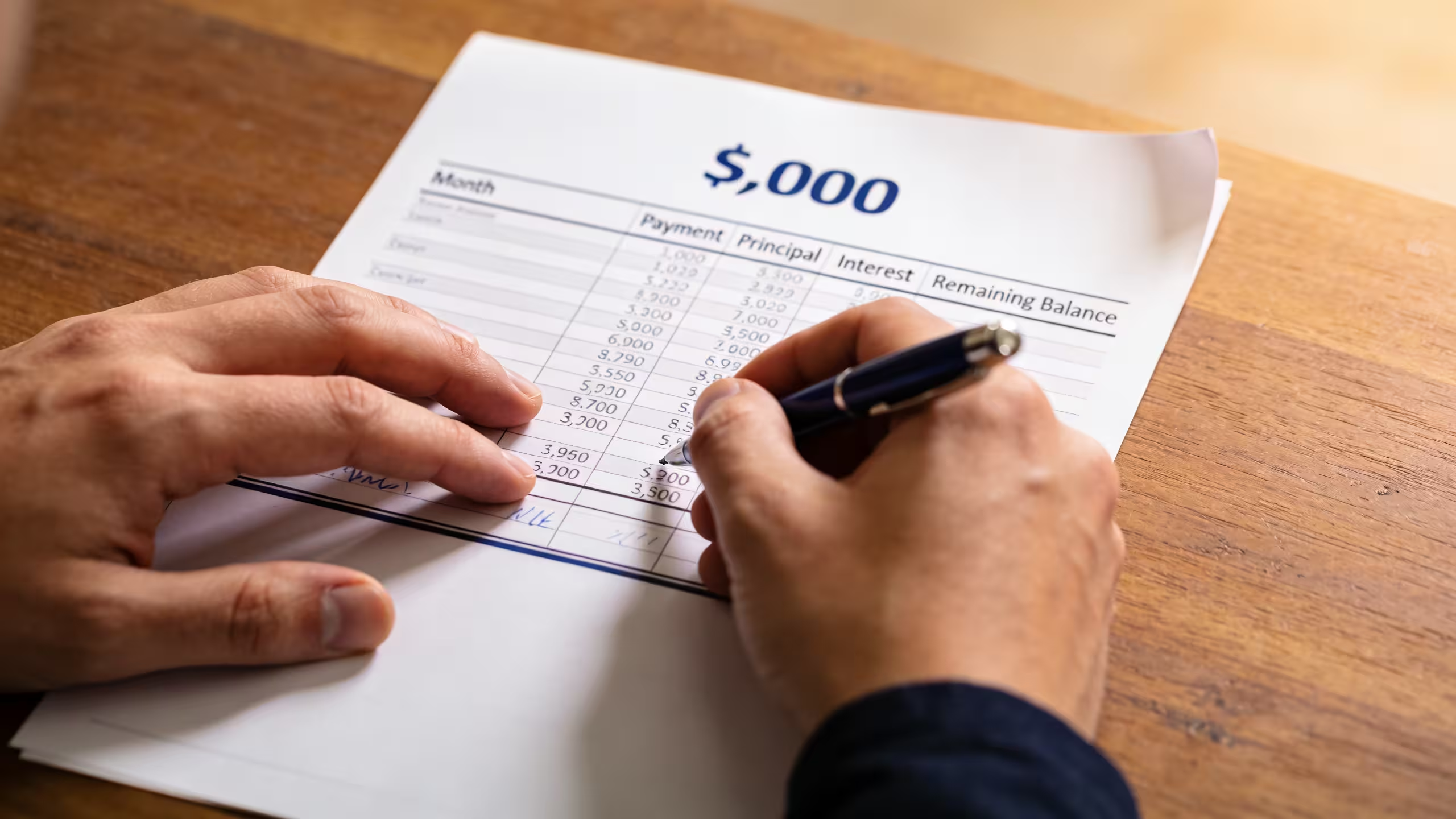
The table below shows estimated monthly payments for a $5,000 loan at four APR levels across three repayment terms. It also shows the total interest you would pay at each combination. Payments are calculated using the standard loan amortization formula. Your actual APR will depend on your credit profile and lender. The Federal Reserve publishes average consumer credit rates at federalreserve.gov/releases/g19, which can give you a useful reference point.
| APR | 24 Months | 36 Months | 60 Months |
|---|---|---|---|
| 10% |
$231/mo $544 total interest |
$161/mo $796 total interest |
$106/mo $1,360 total interest |
| 15% |
$242/mo $808 total interest |
$173/mo $1,228 total interest |
$119/mo $2,140 total interest |
| 20% |
$254/mo $1,096 total interest |
$186/mo $1,696 total interest |
$132/mo $2,920 total interest |
| 30% |
$280/mo $1,720 total interest |
$212/mo $2,632 total interest |
$162/mo $4,720 total interest |
In practice, many borrowers zero in on the monthly payment column and skip the interest totals. Looking at both figures together shows the real cost of that lower payment: at 20% APR, stretching from 24 months to 60 months saves $122 per month but costs an extra $1,824 in interest.
What Determines Your Monthly Payment?
Three factors shape your monthly payment: the APR your lender assigns you, the repayment term you select, and any upfront fees the lender charges. Each one is worth understanding before you sign anything.
Your Credit Profile and the Rate You Qualify For
Lenders assign APRs based on their assessment of how likely you are to repay. The factors they typically review include:
- Your credit score and the full history behind it
- Your debt-to-income ratio (DTI): how much of your gross income already goes to existing debt payments
- Your employment status and income stability
- The length of your credit history
- Whether you have other open installment loans or high credit card balances
Lenders set their own minimum credit score thresholds and rarely publish them. Checking your rate with multiple lenders through a soft inquiry will not affect your credit score. The Consumer Financial Protection Bureau recommends comparing offers from at least a few lenders before making a borrowing decision.
The Loan Term You Choose
The repayment term is the number of months you take to pay back the loan. Longer terms reduce your monthly payment, but they also extend the period during which interest accumulates. Shorter terms raise your payment but reduce what you pay in total.
In reviewing hundreds of loan applications over a decade in consumer lending, the detail most borrowers miss is that the term decision affects the total cost of the loan far more dramatically than most people expect. At 20% APR, choosing 60 months over 24 months costs an additional $1,824 in interest on a $5,000 loan, for the benefit of paying $122 less each month.
If you want to understand how lenders structure repayment schedules from the first payment to the last, our guide on how personal loans work walks through the full process.
Does an Origination Fee Change Your Actual Monthly Cost?
Some lenders charge an origination fee, a one-time processing charge that is typically deducted from the loan proceeds before you receive the funds. On a $5,000 loan with a 5% origination fee, the lender sends you $4,750, but your repayment schedule is calculated on the full $5,000.
This means your effective borrowing cost is higher than the stated APR alone would suggest. You are paying interest on $5,000 but only received $4,750 to use. Always ask whether the origination fee is factored into the APR or charged on top of it. An APR that includes the fee gives you a truer picture of total cost.
For a complete breakdown of how origination fees work and how to compare lenders that charge them against those that do not, see our article on personal loan origination fees.
A Simple Framework for Choosing Your Loan Term
What most people miss when comparing loan offers is that choosing a term is really a choice between two priorities: a manageable monthly payment, or the lowest possible total cost. The right answer depends on your situation.
Loan Term Decision Framework
- If your monthly budget is tight: choose a 48- or 60-month term. Your payment will be lower, but plan for higher total interest costs.
- If your budget can handle a larger payment: choose a 24-month term. You will pay the least total interest and clear the debt sooner.
- If your APR is above 25%: prioritize paying off the loan as fast as your budget allows. At high rates, every extra month adds significant interest.
- If you are unsure: start with 36 months. It balances payment size and total interest cost, and leaves room in your budget for unexpected expenses.
Before you decide, check whether your lender charges a prepayment penalty. If they do not, you can always pay more than the required monthly amount to reduce your interest costs without being locked into a faster schedule from day one.
How to Lower the Total Cost of a $5,000 Loan
From a practical standpoint, the most reliable path to a lower monthly payment and a lower total cost is to improve the factors that drive your APR before you apply. These steps make the most measurable difference:
- Check your credit report before applying. Errors on your report can raise your APR. You can request a free copy from all three major bureaus at AnnualCreditReport.com.
- Pre-qualify with multiple lenders. Soft-pull pre-qualification lets you compare APR offers without affecting your credit score. Use it before submitting any formal application.
- Choose the shortest term your budget can support. Even moving from 60 months to 36 months can save several hundred dollars in interest depending on your rate.
- Ask about autopay discounts. Many lenders reduce your APR slightly when you enroll in automatic payments. Even a small rate reduction adds up over the life of the loan.
- Compare total repayment amounts, not just stated APRs. Two lenders may quote the same rate, but one with an origination fee will cost more overall. Look at the full repayment figure on each loan offer.
If you are deciding between a fixed rate and a variable rate loan, the rate type will also affect your long-term monthly cost. Our overview of fixed vs. variable loan rates covers the key difference and when each type tends to work in a borrower’s favor.
FAQ: How Much Would a $5,000 Personal Loan Cost Monthly?
Tap any question to expand the answer.
What is a typical monthly payment on a $5,000 personal loan?
There is no single typical payment because it depends on the APR and the repayment term your lender offers you. Using the standard amortization formula on a $5,000 loan, payments generally fall between roughly $106 per month at a low rate over 60 months and $280 or more per month at a higher rate over 24 months. The Federal Reserve publishes average consumer credit rates at federalreserve.gov/releases/g19 if you want to see where market averages currently stand. Your specific payment will depend on the APR you qualify for and the term you choose.
How long does it take to pay off a $5,000 personal loan?
Most personal loans are structured with repayment terms ranging from 12 months to 84 months, with 24, 36, and 60 months being the most common options. The term you qualify for and the one you choose will depend on the lender’s offerings and your preference between a lower monthly payment and a lower total interest cost. Choosing a shorter term means higher monthly payments but less total interest paid over the life of the loan. If your lender does not charge a prepayment penalty, you can also pay off the loan ahead of schedule to reduce interest costs.
Does my credit score affect how much I pay monthly on a $5,000 loan?
Yes, your credit score is one of the main factors lenders use to determine your APR, and your APR directly drives your monthly payment. A borrower who qualifies for a 10% APR will pay meaningfully less each month and far less in total interest than a borrower who qualifies for a 25% or 30% APR on the same $5,000 loan. Lenders also consider your income, your debt-to-income ratio, and your payment history, so a strong overall credit profile matters beyond the score number alone. The Consumer Financial Protection Bureau recommends shopping multiple lenders to find the most competitive rate for your profile.
Can I pay off a $5,000 personal loan early to save on interest?
Paying off a personal loan early reduces the total interest you pay because interest accrues on the remaining principal balance each month. If you pay down the balance faster, there is less principal for interest to accumulate on. Before making extra payments, confirm that your lender does not charge a prepayment penalty, which is a fee some lenders charge for paying off a loan ahead of schedule. If no prepayment penalty applies, making even one extra payment per year can noticeably reduce your total interest cost on a multi-year loan.
What is the difference between APR and interest rate on a personal loan?
The interest rate is the base cost of borrowing expressed as an annual percentage of the loan principal. The APR (annual percentage rate) includes the interest rate plus any lender fees, such as an origination fee, rolled into a single annual figure. When comparing loan offers, the APR gives a more accurate picture of total cost than the interest rate alone, because it accounts for fees that vary by lender. Always compare APRs when evaluating two loan offers, not just the stated interest rates.