Full Coverage Auto Insurance Explained: What It Covers and When You Need It
By Laurel C. Yazzie | Last reviewed: September 2026
When you shop for car insurance, you will almost certainly hear the term “full coverage.” It sounds reassuringly complete, like something that protects you in every possible situation. The reality is more nuanced, and understanding what full coverage actually includes can prevent a costly surprise after an accident.
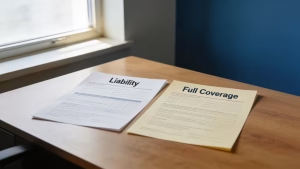
Full Coverage Auto Insurance Explained: Full coverage auto insurance refers to a policy that bundles liability, collision, and comprehensive coverage. Liability pays for damage you cause to others. Collision covers repairs to your vehicle after an accident. Comprehensive covers non-collision damage such as theft, storms, and vandalism. These three coverages work together to protect both you and other drivers.
Having worked directly with clients on auto insurance policies over more than a decade in the industry, the most common misconception I encountered was that full coverage means all possible losses are paid. It does not. Knowing what falls outside your policy is just as important as knowing what falls inside it.
What Is Full Coverage Auto Insurance?
Despite the confident-sounding name, “full coverage” is not an official insurance term. You will not find it defined in any state insurance code, and it will not appear as a line item on your declarations page. According to the Insurance Information Institute, auto policies are built from distinct coverage types, and what people call “full coverage” is simply a common combination of the three most widely purchased.
Lenders and leasing companies use the term frequently because they require borrowers to carry it. If you have an auto loan or lease, your lender almost certainly mandates full coverage for the life of that loan or lease term.
- Liability coverage pays for injuries and property damage you cause to others in an accident.
- Collision coverage pays for damage to your own vehicle after a crash, regardless of fault.
- Comprehensive coverage pays for non-collision damage to your vehicle, such as theft, hail, or fire.
What Does Full Coverage Auto Insurance Cover?
Full coverage auto insurance covers a wide range of situations by combining three separate coverage types into one policy. Here is how each component works in practice.
| Coverage Type | What It Pays For | Required By |
|---|---|---|
| Liability | Injuries to others, damage to others’ property, legal defense if sued | State law (almost all states) |
| Collision | Damage to your vehicle from hitting another car, an object, or a rollover | Lenders and leasing companies |
| Comprehensive | Theft, vandalism, fire, hail, floods, falling objects, animal collisions | Lenders and leasing companies |
Liability Coverage
Liability is the legal floor of auto insurance. Almost every state requires drivers to carry it at a minimum. It splits into two parts: bodily injury liability covers medical costs and lost wages for people you injure in an accident, while property damage liability covers repairs to their vehicle or other property you damage. Liability does not pay anything toward your own car or your own medical bills.
Collision Coverage
Collision coverage applies whenever your vehicle is damaged in a crash, regardless of who is at fault. It pays to repair or replace your car after hitting another vehicle, backing into a pole, running off the road, or a rollover. You choose your deductible at the time of purchase, and your insurer pays the repair cost minus that deductible, up to the vehicle’s current market value.
Comprehensive Coverage
Comprehensive coverage handles the situations collision does not: theft, vandalism, fire, hail, flooding, falling tree branches, and collisions with animals such as deer. From a practical standpoint, drivers in regions with severe weather or high vehicle theft rates see the most value from this coverage type. Like collision, it comes with a deductible you choose when building your policy.
What Full Coverage Does NOT Include
When reviewing policies, one pattern stands out: drivers are routinely surprised by what their “full coverage” policy does not pay for. These are the most common gaps.
- Your medical bills and your passengers’ medical bills are not covered unless you add Medical Payments (MedPay) or Personal Injury Protection (PIP). PIP is required in some states; in others it is optional.
- Damage caused by an uninsured driver is only covered if you add uninsured motorist protection explained to your policy.
- Rental car costs while your vehicle is being repaired require a separate rental reimbursement endorsement.
- Custom equipment or aftermarket parts, such as upgraded wheels or a sound system, are rarely covered at their full installed value without a specific endorsement.
- Personal belongings inside the car, such as a laptop or camera, are not covered by auto insurance. Your renters or homeowners policy typically covers those under personal property protection.
If My Car Is Totaled, Does Full Coverage Pay Off My Loan?
This is the question most drivers discover the hard way. If your car is declared a total loss, your insurer pays its actual cash value (ACV): the market value of the vehicle at the time of the loss, not what you originally paid for it, and not necessarily what you still owe on it.
Consider a driver who purchased a car for $30,000 and financed $28,000 of it. Two years later, the vehicle’s actual cash value is $21,000, but $23,000 remains on the loan. Full coverage pays the insurer’s ACV determination of $21,000. The driver still owes the lender $2,000 out of pocket, with no car to drive.
This gap is exactly what GAP insurance (Guaranteed Asset Protection) is designed to cover. It is an add-on that pays the difference between your insurer’s payout and your remaining loan balance. The National Association of Insurance Commissioners advises consumers to review whether GAP coverage is appropriate whenever financing a vehicle purchase.
When Should You Get Full Coverage Auto Insurance?
Full coverage costs more than liability-only insurance, so the central question is whether the extra protection is worth the premium difference for your specific situation. There is no universal answer, but a practical framework helps.
Get full coverage if any of these apply:
- You have an active auto loan or lease (lender requires it).
- Your car is relatively new or holds significant market value.
- You could not comfortably pay out of pocket to repair or replace your vehicle after a total loss.
- You live in an area with high vehicle theft rates, severe weather patterns, or heavy traffic congestion.
Liability-only may be enough if all of these are true:
- You own your car outright with no lender involved.
- Your car’s current market value is low enough that a payout would be modest.
- You have sufficient savings to absorb a repair or a vehicle replacement without serious financial hardship.
What most people miss when reviewing their policy is the relationship between their deductible and their vehicle’s current value. If your car is worth $4,000 and your collision deductible is $1,000, the most your insurer would pay after a total loss is $3,000. At some point, the annual premium for collision and comprehensive may not be justified by that potential payout.
When Can You Drop Full Coverage?
A general guideline used in the industry is to reconsider collision and comprehensive coverage when their combined annual premium approaches a significant percentage of your car’s current market value. You can find current vehicle market values through your state’s department of motor vehicles or published valuation resources. Keep in mind: dropping collision and comprehensive does not mean dropping liability. Liability coverage is legally required in almost every state, regardless of your vehicle’s age or value. For a detailed comparison of the tradeoffs involved, see our guide on liability versus full coverage.
How Deductibles Work with Full Coverage
Both collision and comprehensive coverage come with a deductible: the amount you pay out of pocket when you file a claim before the insurer covers the rest. Choosing the right deductible involves a trade-off between your monthly premium and your exposure after a loss.
- Higher deductible: lowers your monthly or annual premium but increases what you owe after a claim.
- Lower deductible: raises your premium but reduces your out-of-pocket cost at claim time.
- Collision and comprehensive deductibles are set independently. You can carry a higher deductible on one and a lower deductible on the other.
- Liability coverage does not carry a deductible. Your insurer pays the covered amount directly to the other party.
For a closer look at how these two coverages interact, see how collision and comprehensive coverage compare. For a full overview of all auto insurance coverage types and how they work together, visit the auto insurance resource center.
FAQ: Full Coverage Auto Insurance Explained
Tap any question to expand the answer.
Is full coverage auto insurance required by law?
Full coverage is not required by state law. Most states require drivers to carry liability insurance at minimum, but the decision to add collision and comprehensive coverage is generally up to the driver. The exception is when you have an auto loan or lease: lenders and leasing companies typically require full coverage for the duration of the financing term to protect their financial interest in the vehicle.
Does full coverage pay for a rental car while mine is being repaired?
Not automatically. Rental reimbursement is a separate endorsement that must be added to your policy. Standard full coverage, which includes liability, collision, and comprehensive, does not include rental car costs by default. If rental access during a repair period is important to you, ask your insurer specifically about adding rental reimbursement coverage when you build or review your policy.
What is the difference between full coverage and liability-only insurance?
Liability-only insurance covers damage you cause to other people and their property, but pays nothing toward your own vehicle. Full coverage adds collision and comprehensive to that base, so your insurer also helps pay to repair or replace your car after an accident, theft, or weather damage. The trade-off is cost: full coverage carries a higher premium, which may or may not be justified depending on your car’s current value and your financial situation.
Can I have full coverage on an older or lower-value car?
Yes, insurers will generally sell you full coverage on any vehicle, regardless of age or value. Whether it makes financial sense is a different question. On an older car with a low market value, the payout after a total loss may be modest, potentially less than what you pay in premiums for collision and comprehensive over a year or two. If your car’s current market value is low, compare the potential insurance payout against your annual collision and comprehensive premium to decide whether the coverage is cost-effective.
Does full coverage pay my medical bills after a car accident?
Not automatically. The three standard components of full coverage (liability, collision, comprehensive) do not include coverage for your own medical expenses or your passengers’ medical bills. To fill that gap, you would need to add Medical Payments coverage (MedPay) or Personal Injury Protection (PIP) to your policy. PIP is required in some no-fault states; in others it is optional. Check your state’s minimum requirements with your insurer or your state’s insurance commissioner.