Liability vs Full Coverage Auto Insurance: What’s the Real Difference?
By Laurel C. Yazzie | Last reviewed: August 2026
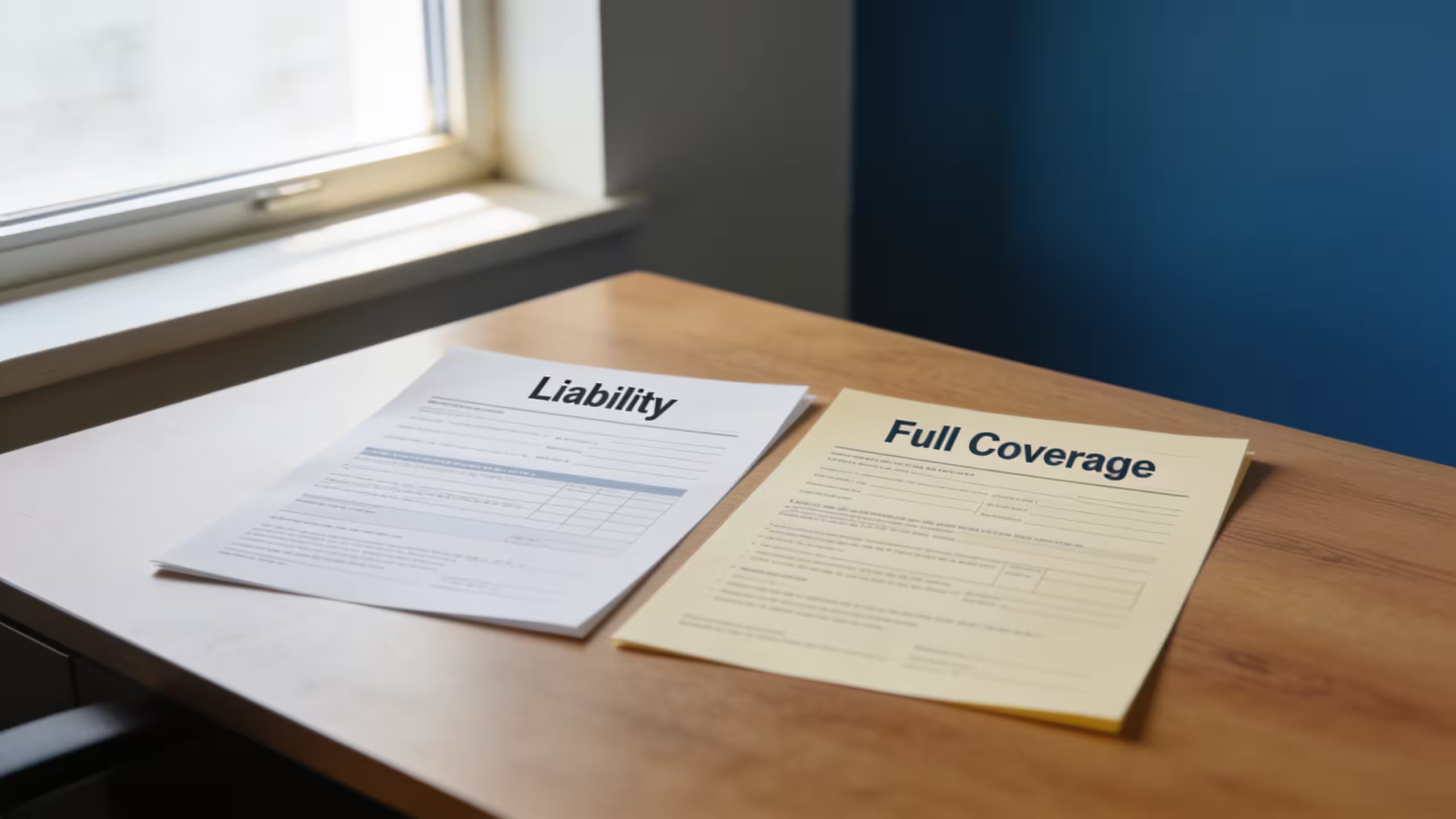
When you shop for auto insurance, the choice often comes down to liability vs full coverage auto insurance. Most drivers know both options exist, but fewer understand exactly what separates them, what happens after a real accident under each type, and when the higher cost of full coverage actually makes financial sense for your specific situation.
Having worked directly with clients on auto policy reviews during renewal seasons, the most common misconception I encountered was that full coverage meant the insurer would pay for anything that happened to the car. It does not. Understanding exactly what each option covers changes how you evaluate the price difference and what you are actually risking by choosing the lower-cost path.
What Liability Insurance Actually Covers
Liability insurance is the only type of auto coverage required by law in almost every state. It protects other people on the road when you are at fault in an accident. It does not pay anything toward your own vehicle or your own medical bills.
Liability splits into two parts:
- Bodily injury liability: Pays the medical expenses, lost wages, and legal fees of other people injured in an accident you cause. If you are sued following the accident, it can also cover your legal defense costs.
- Property damage liability: Pays for repairs to another person’s vehicle or property that you damage in an at-fault accident. This includes vehicles, fences, mailboxes, and other structures.
State law sets minimum required limits for both parts. Those minimums are often low enough that a single serious accident can exceed them entirely. If your liability limits are exhausted, you are personally responsible for any amount above your policy limit.
What “Full Coverage” Actually Means
“Full coverage” is not a formal insurance term. No state defines it in law, and no insurer sells a product by that exact name. When drivers, lenders, and dealerships use the phrase, they mean a policy that combines the state-required liability coverage with two physical damage coverages: collision and comprehensive.
- Collision coverage: Pays to repair or replace your vehicle after a collision with another car or object, regardless of who caused the accident. You pay your deductible first; the insurer pays the rest up to the car’s actual cash value.
- Comprehensive coverage: Pays for damage to your vehicle from causes other than a collision. This includes theft, vandalism, hail, fire, flooding, and animal strikes such as hitting a deer.
Some full coverage policies also bundle in uninsured/underinsured motorist coverage and medical payments coverage. Whether those are included or optional depends on your state and the specific policy you select. To understand how each of these coverage types functions within a complete policy, see our guide on how auto insurance coverage types work.
Liability vs Full Coverage Auto Insurance: Side-by-Side Comparison
The table below shows exactly which events and expenses each option covers. Every row marked “No” under liability-only is a gap you would be covering entirely out of pocket if that event occurred. The interactive version in the comparison tool below this section lets you click each row for a fuller explanation.
| Coverage Feature | Liability Only | Full Coverage |
|---|---|---|
| Damage and injuries you cause to others | Yes | Yes |
| Repairs to your own vehicle after a collision | No | Yes |
| Vehicle theft | No | Yes |
| Hail, fire, flood, or weather damage | No | Yes |
| Your own medical bills after an accident | No* | No* |
| Required by state law | Yes, most states | Only if financed or leased |
| Deductible applies on claims | No | Yes (collision and comprehensive) |
| Premium level | Lower | Higher |
*Your own medical bills require adding Medical Payments (MedPay) or Personal Injury Protection (PIP) separately. Neither is included automatically in liability-only or standard full coverage.
The single most important line in that table is the collision row. Under a liability-only policy, any damage to your own vehicle, whether you caused the accident or not, comes out of pocket. There is no claim to file on your own behalf.
How Much Does the Cost Difference Add Up To?
Full coverage is meaningfully more expensive than liability-only. The exact gap varies by driver and vehicle, driven primarily by these factors:
- Vehicle age and market value: The insurer’s maximum payout on a physical damage claim is capped at your car’s actual cash value. A higher-value vehicle carries a larger premium for collision and comprehensive.
- Make and model: Theft frequency and historical repair costs for your specific vehicle affect what the insurer charges to cover it.
- Where you live: States and zip codes with higher accident rates, severe weather frequency, or vehicle theft rates push premiums up.
- Your driving history: At-fault accidents and moving violations raise your rate across all coverage types.
- Your chosen deductible: A higher deductible for collision and comprehensive lowers your premium but increases what you pay out of pocket after a claim.
According to the Insurance Information Institute, the physical damage coverages that define full coverage are priced based on the vehicle’s replacement cost, its theft frequency by make and model, and the cost history of claims for similar vehicles. A newer car with high replacement value carries a larger premium gap than an older car with low book value, which is exactly why the calculation changes as a vehicle ages.
The National Association of Insurance Commissioners (NAIC) provides a shopping guide that explains what rating factors insurers are permitted to use in each state. Checking it can help you understand why your quoted premium lands where it does and which factors you can realistically influence.
One practical way to evaluate whether the cost is justified: compare the annual premium for collision and comprehensive on its own against your vehicle’s current market value. If those two coverages together cost more than 10 percent of what the car is worth, the cost-benefit math of full coverage has shifted, especially on older vehicles.
When Should You Switch to Liability Only?
Liability-only coverage is a reasonable financial choice for some drivers, but only when specific conditions are met. The most common mistake is dropping full coverage because the premium feels high, without verifying that a single event such as a theft or a major collision would not cost far more than the total savings.
Decision Framework: Keep or Drop Full Coverage?
Stay with full coverage if any one of these applies:
- Your car is financed or leased (your lender requires it)
- You could not cover a major repair or full replacement without financial hardship
- Your vehicle still has significant remaining market value
- You live in an area with high vehicle theft rates or frequent severe weather
- The annual cost of collision and comprehensive is less than 10% of your car’s current value
Liability-only may be appropriate only if all of the following are true:
- Your car is fully paid off and you own it outright
- The annual collision and comprehensive premium exceeds 10% of the car’s current market value
- You have savings available to absorb a repair or full replacement without going into debt
- A total-loss payout at actual cash value would be modest enough to manage out of pocket
What Happens When You Pay Off Your Car Loan?
Paying off a car loan is the most common trigger for this comparison search. Once the loan is satisfied, your lender’s requirement for full coverage disappears. You own the vehicle outright, and no institution is dictating your coverage level. That moment is not automatically a reason to drop full coverage. It is a reason to run the numbers.
Look up your car’s current market value, then check what the collision and comprehensive portion of your premium actually costs on its own. If you drop both coverages and your car is later stolen, totaled, or caught in a hailstorm, the premiums you saved are the only financial cushion you have toward replacing it.
From a practical standpoint, the right question is not “Do I still need full coverage?” but “Could I absorb this loss if it happened next month?” A driver with a solid emergency fund and a lower-value paid-off vehicle is in a very different position than a driver with limited savings and the same car. Coverage decisions should reflect that difference, not just the monthly premium.
When Full Coverage Is Worth the Extra Cost
For a large share of drivers, full coverage is either required or clearly the better financial decision. What most people miss when reviewing their policy is that comprehensive claims, the ones for theft, hail, fire, and flooding, are losses that arrive without any warning at all. A collision you might see coming. A car stolen overnight or hail dropping on your vehicle in a parking lot you cannot anticipate.
Full coverage makes clear financial sense when:
- Your car is financed or leased and your lender requires it
- Your vehicle has enough remaining market value that a loss would represent a serious financial setback
- You live in an area with high theft rates, frequent severe weather, or a high proportion of uninsured drivers
- You do not have ready savings to cover unexpected repairs or a full replacement
- Your deductible is set at a level you can afford, making the net cost of a claim manageable
Does the Cost of Full Coverage Go Down Over Time?
Yes, generally. As a vehicle ages and its market value declines, the comprehensive and collision portions of your premium tend to decrease as well. This is because the insurer’s maximum payout on a physical damage claim is capped at the car’s actual cash value at the time of the loss. A lower-value car carries a smaller potential payout, which lowers the cost of insuring it for physical damage.
Reviewing your coverage at each renewal, especially once your car crosses into lower book-value territory, is a useful habit for managing this cost over the life of the vehicle. For a detailed look at the factors that shape your premium year over year, including vehicle type, location, and driving record, see our guide on what drives your auto insurance rate.
For a full overview of all auto insurance topics, from how deductibles work to what your policy excludes, visit our auto insurance resource center.
Compare: Liability vs Full Coverage Auto Insurance
Click any row to expand the explanation for that coverage feature.
| Coverage Feature | Liability Only | Full Coverage |
|---|
Coverage availability and requirements vary by state and insurer. Always review your declarations page to confirm what you carry.