What Does Auto Insurance Actually Cover?
By Laurel C. Yazzie | Last reviewed: June 2026
Most people pay their auto insurance premium every month without a real answer to what does auto insurance actually cover when a claim gets filed. The word “actually” is doing a lot of work in that question. It signals a gap between what drivers expect their policy to do and what it is contractually required to pay for.
Having worked directly with clients on auto insurance policy reviews, the most common misconception I encountered was that a standard policy is one blanket of protection. In reality, it is a stack of separate coverages, each activated by a different type of event, and most drivers are only carrying some of them.
What does auto insurance actually cover: Auto insurance covers several separate protections bundled into one policy. The most common types include liability, collision, comprehensive, uninsured motorist, and medical payments. Each type responds to a different situation. Most drivers carry only some of these, leaving real gaps in their coverage without realizing it.
What Does Auto Insurance Actually Cover?
Think of your policy as a set of separate switches rather than one safety net. Each coverage type activates in a specific scenario. If that switch is not on your policy, no claim gets paid when that scenario happens.
According to the Insurance Information Institute, standard personal auto policies are built from several distinct coverage categories. You may carry all of them, or only the ones your state requires.
- Liability: Covers damage and injuries you cause to others in an accident you are responsible for
- Collision: Covers damage to your own vehicle from a crash you are involved in
- Comprehensive: Covers non-crash damage to your vehicle, including theft, weather, and animals
- Uninsured/Underinsured Motorist: Covers you when the at-fault driver has no insurance or not enough
- Medical Payments (MedPay) / PIP: Covers medical costs for you and your passengers regardless of fault
- Gap Coverage: Covers the difference between your outstanding loan balance and your car’s depreciated value
The sections below focus on the coverage types that surprise drivers most. Those are the ones most likely to leave you exposed when it counts. For a broader look at how all these pieces fit together, the 1TopLife auto insurance guide is a useful starting point.
Liability Coverage Protects Others, Not Your Own Car
Liability is the coverage your state legally requires you to carry. It is also the coverage most drivers fundamentally misunderstand. Liability does not repair your vehicle. It pays for the damage you cause to another person’s car and covers their medical bills if you are at fault in an accident. Your own vehicle is simply not part of the equation.
In practice, many drivers believe that because they have insurance, their own car is protected after any crash. That is only true if they also carry collision coverage, which is a completely separate add-on with its own deductible and its own line on your premium.
- You caused the accident → Your liability pays the other driver’s bills. Your car is not covered.
- The other driver caused it → Their liability pays your bills. If they have none, see uninsured motorist below.
- Your own car needs repairs after a crash → Only your collision coverage helps your vehicle.
- Your car was damaged by weather, theft, or an animal → Only your comprehensive coverage applies.
How Much Liability Coverage Is Actually Enough?
Every state sets a minimum liability requirement, but those minimums are often far below the real cost of a serious accident. If your liability limits run out, you pay the remaining damages out of your own pocket. The National Association of Insurance Commissioners advises drivers to consider their total assets when selecting liability limits, not just the state minimum. A lawsuit after a serious accident can reach savings, home equity, and future wages if your policy limit falls short.
- Treat state minimums as a legal floor, not a recommended coverage level
- Factor in your net worth and annual income when choosing limits
- Ask your insurer about umbrella policies if you want protection beyond standard auto limits
Collision vs. Comprehensive: These Are Not the Same Coverage
Both collision and comprehensive are optional coverages that protect your own vehicle. The difference is what caused the damage. Collision applies when your car hits something or something hits your car while it is moving: another vehicle, a guardrail, a utility pole, or a single-car rollover. The key factor is a moving impact involving the vehicle itself.
Comprehensive covers damage from events that do not involve a driving collision: theft, vandalism, fire, flooding, hail, or an animal running into your path. A cracked windshield from a rock on the highway is a comprehensive claim. Backing into a pole in a parking lot is a collision claim.
- Collision: Your car hits something, or something moving hits it while it is in use
- Comprehensive: Damage caused by weather, animals, fire, theft, or falling objects
- Both carry a deductible you pay before insurance covers the remaining cost
- If your car is financed or leased, your lender almost certainly requires both
Does Auto Insurance Cover You When Someone Else Is Driving Your Car?
This edge case catches drivers off guard more often than almost any other coverage question. In most states, auto insurance follows the car rather than the driver. If you give someone permission to use your vehicle and they cause an accident, your policy is generally the one that responds first, not theirs.
What most people miss when reading their policy is the distinction between a permissive driver and an excluded driver. A permissive driver is someone you allowed to borrow the car. An excluded driver is someone who was formally removed from your policy, usually to lower your premium when a household member has a poor driving record. If an excluded driver causes an accident in your vehicle, your insurer will typically deny the claim entirely, even if you gave your permission that day.
The rules also differ for occasional borrowers versus regular household users. Someone who drives your car once or twice a year is treated differently than a family member who uses it every week. If anyone in your household uses your vehicle regularly, contact your insurer to confirm whether they need to be listed on your policy before an accident happens.
Uninsured and Underinsured Motorist Coverage
Many drivers drop this coverage when looking for ways to reduce their premium. That trade-off can be costly. If a driver with no insurance, or with limits too low to cover your losses, causes an accident and injures you, their policy cannot make up the shortfall. Your uninsured or underinsured motorist coverage steps in to fill exactly that gap.
According to the Insurance Information Institute, a meaningful share of drivers on American roads carry no auto insurance at all. Being hit by one of those drivers without this coverage can leave you personally responsible for medical bills and vehicle repairs that should never have been your cost to begin with.
- Uninsured motorist (UM): The at-fault driver carries no insurance at all
- Underinsured motorist (UIM): The at-fault driver has insurance, but their policy limits fall short of covering your full losses
- Some states require UM/UIM coverage by law; others offer it as optional but recommended
- Check your state’s requirements through the National Association of Insurance Commissioners
Medical Payments and Personal Injury Protection (PIP)
Many drivers assume their health insurance will cover any medical costs that arise from a car accident. Health insurance can play a role, but it does not always process quickly after a crash, and it generally does not cover passengers who are not enrolled in your health plan. That gap is exactly what MedPay and PIP are designed to fill.
Medical Payments coverage and Personal Injury Protection both pay for medical expenses after an accident regardless of who caused it. PIP is the broader option: beyond hospital bills, it can cover lost wages and rehabilitation costs. Both coverages can apply to you, your passengers, and in some states pedestrians involved in an accident with your vehicle.
- MedPay: Covers medical bills only; available in most states as an optional add-on
- PIP: Covers medical bills plus lost wages and rehabilitation; required in no-fault states
- Both pay out regardless of fault, which can speed up reimbursement before fault is determined
- If your health plan carries a high deductible, MedPay can cover that out-of-pocket amount first
What About Rental Cars During a Repair Period?
A follow-up question many drivers have after learning about collision and comprehensive coverage is whether their policy also pays for a rental vehicle while their car is being repaired. That is handled by a separate optional add-on called rental reimbursement coverage, and it is not automatically included in a standard policy. Our guide on auto insurance and rental cars explains exactly when and how your policy will cover a rental vehicle, and what the common exclusions are.
How to Check What Your Policy Actually Includes
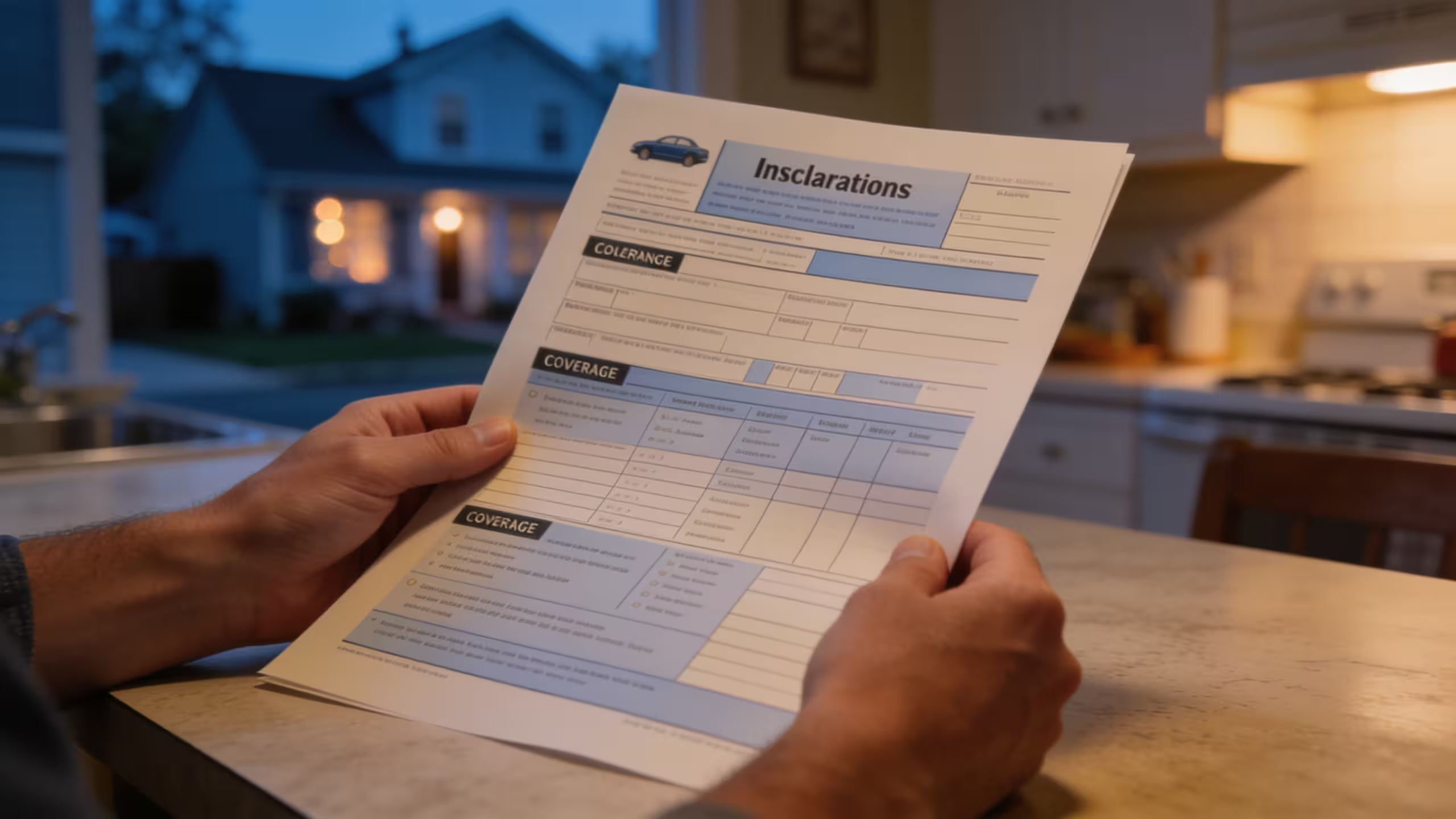
Your declarations page is the fastest way to see what you are actually paying for. It is typically the first page of your policy and lists every coverage type you carry, the dollar limit for each one, and your deductible amounts. If a coverage type does not appear on that page, you do not have it, regardless of what you may have assumed when you originally signed up.
From a practical standpoint, the most useful step you can take before an accident happens is to call your insurer and walk through two or three hypothetical scenarios. Ask what happens if your car is stolen overnight. Ask what your total out-of-pocket cost would be if an uninsured driver ran a red light and hit you tomorrow. Those answers will show you exactly where your coverage stops.
- Pull up your declarations page and confirm which coverage types are currently active
- Note each deductible amount and confirm you could cover it in an emergency
- Compare your coverage limits to your car’s current market value
- Confirm whether your state requires any coverage you are not currently carrying
Knowing what is covered is only one part of the picture. The companion article on what auto insurance does not cover walks through the gaps that even well-covered drivers regularly overlook. And if you want to understand how an auto policy is structured from the ground up, the guide on how auto insurance works covers the full mechanics behind every coverage type.
FAQ: What Does Auto Insurance Actually Cover?
What is the difference between collision and comprehensive auto insurance?
Collision covers damage your car sustains from hitting another vehicle, a stationary object, or from a rollover. Comprehensive covers damage from events that do not involve a driving impact: theft, vandalism, hail, flooding, fire, or a collision with an animal. A tree falling on your parked car is a comprehensive claim; driving your car into that same tree is a collision claim. Both are optional coverages, but lenders typically require both if your vehicle is financed or leased.
Does auto insurance cover medical bills if I am injured in a car accident?
Auto insurance can cover medical expenses through two specific coverages: Medical Payments (MedPay) and Personal Injury Protection (PIP). Both pay for medical costs after an accident regardless of who caused it, and can apply to you, your passengers, and in some states pedestrians you injure. PIP is required in no-fault states and also covers lost wages and rehabilitation costs, which standard health insurance does not. Your health plan may also apply, but MedPay and PIP can pay more quickly before a fault determination is made.
What happens if an uninsured driver causes an accident and hits me?
If an uninsured driver causes an accident and injures you or damages your vehicle, their policy cannot compensate you because no policy exists to collect from. Uninsured motorist coverage is the protection designed for exactly this situation: your own insurer steps in to cover your medical bills and vehicle damage up to your selected policy limit. Without this coverage, your realistic options are limited to suing the at-fault driver directly, which is often slow and difficult to collect on. Checking whether your state legally requires uninsured motorist coverage is a smart first step when reviewing your declarations page.
Does my auto insurance cover someone else if they drive my car?
In most states, auto insurance follows the car rather than the driver, so if you give someone permission to use your vehicle, your policy typically responds first if they cause an accident. However, this general rule has important exceptions. If the person was formally excluded from your policy, or used the vehicle without your permission, your insurer may deny the claim entirely. Anyone who drives your car on a regular basis should generally be listed on your policy to ensure full coverage applies when it is needed.
Is liability insurance the only coverage the law requires me to carry?
Liability coverage is the only type legally required in the vast majority of states, but the required minimums are often far below the actual cost of a serious accident. Optional coverages such as collision, comprehensive, uninsured motorist, and medical payments are not legally mandated in most states, but each one protects against a scenario that liability alone cannot address. For example, liability coverage will not pay to repair your own car or cover your own medical bills after a crash you caused. Reviewing both your state’s mandates and your personal financial situation is the most reliable way to decide which optional coverages belong on your policy.