Personal Loan for Debt Consolidation Explained
By Laurel C. Yazzie | Last reviewed: August 2026
Managing multiple debt payments each month gets complicated fast. Different due dates, different rates, and different minimum payments across three or four accounts leaves a lot of room for a missed payment to slip through. A personal loan for debt consolidation is one of the most common ways to simplify that picture, and for borrowers carrying high-interest credit card balances, it can also lower what you pay in interest overall. But consolidation is not automatically beneficial, and the math matters before you apply.
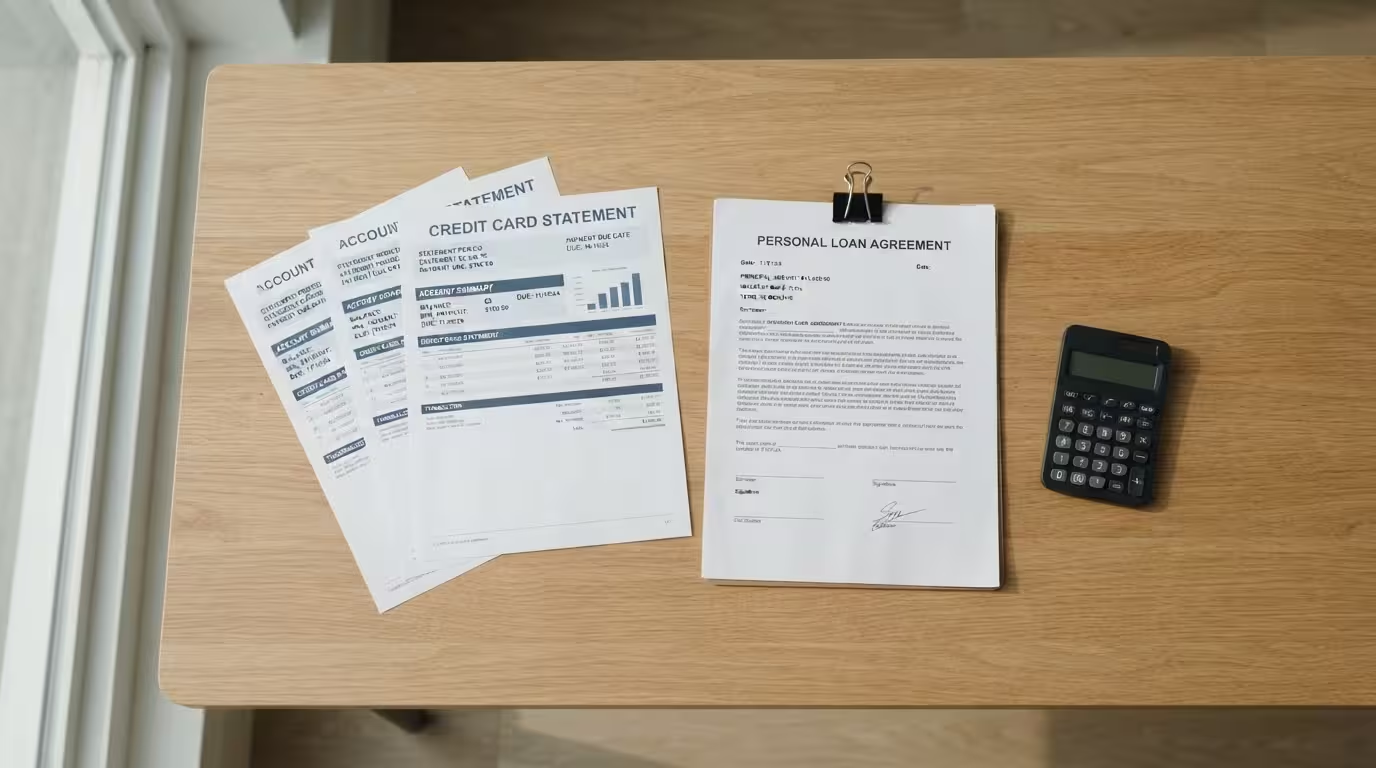
Personal Loan for Debt Consolidation: A personal loan for debt consolidation is an unsecured, fixed-rate installment loan used to pay off multiple existing debts, leaving you with one monthly payment. The Consumer Financial Protection Bureau explains these loans simplify how many payments a borrower makes. The real savings come when the new loan carries a lower interest rate than the debts it replaces.
What Is a Personal Loan for Debt Consolidation?
A debt consolidation loan is not a unique product category. It is a standard personal loan that you apply for with a specific purpose in mind: paying off other debts. When a lender markets a “debt consolidation loan,” they are offering an unsecured personal loan. The label describes the intended use, not a structurally different loan type.
Having worked directly with clients on loan applications for debt consolidation, the most common mistake I saw was treating a new consolidation loan as a financial reset rather than a restructuring. The balances do not disappear. They move from several accounts to one, with a new repayment schedule and a new rate.
- Unsecured: No collateral required. Approval rests on your credit history and income.
- Fixed rate: Your interest rate and monthly payment remain the same from the first payment to the last.
- Fixed term: You have a defined payoff date, Loan terms commonly range from two to seven years, though this varies by lender.
- Lump sum: Funds are deposited to your bank account or, with some lenders, sent directly to your creditors.
According to the Consumer Financial Protection Bureau, debt consolidation loans from banks, credit unions, and installment lenders convert multiple debt obligations into a single payment. The terms, rates, and eligibility requirements vary widely across lenders.
How a Personal Loan for Debt Consolidation Works
The process follows a clear sequence. You apply for a loan equal to the total balance you want to pay off. If approved, you use those funds to close out the existing accounts. From that point, you make one fixed monthly payment on the new loan until it is fully paid off.

- Add up your total debt. List every account you want to consolidate and total the balances. That figure is the loan amount you need to apply for.
- Prequalify with multiple lenders. Most lenders offer a soft-pull prequalification that estimates your rate and terms without a hard credit inquiry. Compare at least two to three offers before proceeding.
- Check the APR, not just the payment. A lower monthly payment is not proof of interest savings. The annual percentage rate (APR) on the new loan must be compared against what you currently pay across existing accounts.
- Submit a full application. Once you choose a lender, a formal application and a hard credit inquiry follow.
- Pay off the existing accounts. Some lenders send funds directly to your creditors. Others deposit the amount into your bank account and leave the payoff to you. Confirm which method the lender uses before you accept the loan.
- Begin monthly payments on the new loan. Your first payment is typically due within 30 days of funding, confirm the exact date with your lender and continues until the balance reaches zero.
To understand how amortization works inside a personal loan, including how interest and principal are applied each month, see our guide on how loan repayment is structured.
When Consolidation Saves You Money: The Rate Test
Whether consolidation reduces what you pay depends on one comparison: the APR on the new loan versus the weighted average APR across the debts you are consolidating. This is the check most borrowers skip, and it is the reason some people consolidate and end up paying more in total than if they had stayed on their existing payment plans.
The Rate Test: Three Steps Before You Apply
Step 1. List every account you want to consolidate with its current balance and interest rate.
Step 2. For each account, multiply the balance by the interest rate. Add those figures together, then divide by your total balance. This gives your weighted average rate across all debts.
Step 3. Compare that number to the APR offered on the consolidation loan.
New loan APR lower than your weighted average rate: Consolidation has the potential to reduce your total interest cost.
New loan APR equal to or higher than your weighted average rate: Consolidation offers payment simplicity but not interest savings. Factor that into your decision.
In practice, many borrowers focus on the monthly payment when comparing options, not the total cost. A lower monthly payment can reflect a longer loan term rather than a lower rate. Stretching the same balance over more months reduces the payment but increases the amount you pay in total.
What If the Lower Payment Actually Costs You More?
This is the most common consolidation trap. A borrower with several credit card balances consolidates into a personal loan with a lower monthly payment and assumes they are saving money. But if the new loan carries a similar or only slightly lower rate and extends the repayment period by several years, the total interest paid over the life of that loan can exceed what the original payoff trajectory would have cost. The check is simple: multiply your new monthly payment by the number of months in the loan term, then subtract the amount borrowed. That difference is your total interest cost on the new loan. Compare it honestly against the path you were already on. The Federal Reserve’s G.19 Consumer Credit statistical release publishes average interest rates for personal loans and credit cards, giving you a benchmark to evaluate whether a quoted rate is competitive before you sign.
Pros and Cons of a Personal Loan for Debt Consolidation
Consolidation has real advantages and real limitations. Both deserve equal weight.
| Potential Advantages | Potential Disadvantages |
|---|---|
| Single monthly payment replaces multiple bills | A longer loan term can increase your total interest paid |
| Fixed rate and known payoff date | Origination fees reduce the net proceeds you actually receive |
| May reduce total interest if the new rate is lower | Approval and rate depend heavily on your credit profile |
| Paying off revolving balances can lower your credit utilization | Does not address the spending habits that produced the debt |
| Replaces variable credit card rates with a fixed rate | Hard credit inquiry temporarily reduces your score at application |
The Consumer Financial Protection Bureau cautions that consolidation is unlikely to succeed if a borrower continues making new purchases on the accounts that were paid off. When the original credit card balances rebuild while the consolidation loan is still being repaid, total debt grows rather than shrinks.
How Debt Consolidation Affects Your Credit Score
Credit score impact is one of the most common follow-up concerns for borrowers considering consolidation. The effects depend on timing and on behavior after the loan is funded.
- Hard inquiry at application: Applying triggers a hard credit pull, which typically causes a small, temporary dip in your score.
- New installment account added: A new account appears on your credit report. This can briefly reduce your average account age.
- Credit utilization drops: Paying off credit card balances lowers your revolving utilization ratio. For borrowers with high card balances relative to their limits, this is often the most significant positive score effect, and it can show up quickly.
- Payment history builds over time: Each on-time monthly payment on the consolidation loan strengthens your payment history, which is the most heavily weighted factor in most credit scoring models.
For most borrowers who stay current on the new loan and do not rebuild card balances, debt consolidation tends to have a positive credit effect over the medium term. For a deeper look at how each borrowing product affects your credit differently, our guide on how consolidation compares to credit card debt covers the mechanics in plain terms.
Is a Personal Loan for Debt Consolidation Right for You?
Consolidation works well under a specific set of conditions. It is less effective when those conditions are not in place.
Consolidation tends to make sense when:
- You have multiple high-rate credit card balances and can qualify for a meaningfully lower APR
- You want a defined payoff date and minimum payments on revolving accounts are not getting you there
- Your credit score and income are strong enough to access a competitive rate
- You are committed to not rebuilding balances on the accounts you pay off
Consolidation is less likely to help when:
- The loan rate you can qualify for is not lower than your current weighted average debt rate
- Spending habits that produced the debt have not changed
- Origination fees on the loan offset the interest savings in the near term
What most people miss when comparing loan offers is the impact of origination fees on actual proceeds. A fee deducted from your loan disbursement means you may need to borrow slightly more than your combined payoff balance to fully clear all the accounts you are consolidating. Confirm the net amount you will receive before signing. For a full library of guides covering every part of the personal loan process, visit our personal loan guides and resources.
FAQ: Personal Loan for Debt Consolidation
Tap any question to expand the answer.
Is a personal loan for debt consolidation different from a regular personal loan?
No. A debt consolidation loan is a standard personal loan used for a specific purpose: paying off other debts. The product itself is the same unsecured installment loan available from banks, credit unions, and online lenders. Some lenders market it under the “debt consolidation loan” label as a way to signal its intended use, but the loan structure, approval process, and legal terms are the same as any other personal loan. The distinction is in what you do with the funds, not in the loan product itself.
Does a debt consolidation loan hurt your credit score?
Applying for a consolidation loan triggers a hard credit inquiry, which typically causes a small, temporary dip in your score. After the loan is funded and you use it to pay off credit card balances, your revolving credit utilization drops, and that change is often the largest positive credit score effect from consolidation. On-time monthly payments on the new installment loan also build your payment history over time. For most borrowers who stay current and do not rebuild card balances, the net credit impact of debt consolidation over six to twelve months tends to be positive.
Can I consolidate debt if I have bad credit?
It is possible to obtain a consolidation loan with a lower credit score, but the rate offered will be higher, and the financial benefit may be reduced or eliminated as a result. Lenders set their own minimum credit requirements, which they rarely publish publicly. The most reliable way to find out what you can access is to prequalify with multiple lenders using a soft credit pull, which does not affect your score. If the rates available to you are not meaningfully lower than what you currently pay across your debts, consolidation offers simplicity but not interest savings in your situation.
What happens if I keep using my credit cards after consolidating?
If you rebuild credit card balances after consolidating, your total debt increases rather than decreases. You would now owe both the consolidation loan payment and growing card minimums, which is a worse position than before you consolidated. The Consumer Financial Protection Bureau specifically warns that consolidation is unlikely to succeed if spending on the original accounts continues after the balances have been paid off. Keeping the paid-off cards open at a zero balance, or a very low balance, is typically the better strategy for both debt management and credit utilization.
How do I calculate whether a consolidation loan will save me money?
Start with your weighted average rate: for each account you want to consolidate, multiply its balance by its interest rate, add those figures together, then divide the total by your combined balance. Compare that rate to the APR on the consolidation loan. If the new loan’s APR is lower, consolidation has the potential to reduce your total interest cost, provided the loan term does not extend significantly. To verify the final savings, multiply your new monthly payment by the number of months in the loan term and subtract the amount borrowed. That is your total interest cost on the new loan, and it should be lower than what your current debt trajectory would cost over the same period.