
What Is Student Loan Deferment?
By Laurel C. Yazzie | Last reviewed: September 2026
If you are struggling to keep up with your student loan payments, you have probably heard the word deferment. But understanding what student loan deferment actually does, and what it costs you in the long run, is what turns a temporary fix into a smart financial decision. This guide explains exactly how deferment works, who qualifies, and when another option may serve you better.
Student loan deferment is a temporary pause on your required federal student loan payments. During deferment, you are not required to make payments for an approved period. Interest does not accrue on subsidized loans, but it continues to accumulate on unsubsidized loans. You must apply with your loan servicer and qualify based on your specific situation.
What Is Student Loan Deferment?
Student loan deferment is a formal, approved pause on your required monthly loan payments. According to the Consumer Financial Protection Bureau, deferment is available for specific situations such as active duty military service and re-enrollment in school. You are not in default during an approved deferment, and the pause will not be reported as a missed payment to the credit bureaus.
Deferment is not automatic and it is not a cancellation of debt. The loan still exists, and for most loan types, interest continues to build. What changes is the requirement to make a payment during the approved window.
- Deferment must be requested and approved by your loan servicer.
- You must continue making payments until you receive written confirmation that deferment is approved.
- Federal deferment is available only for qualifying reasons defined by the U.S. Department of Education.
- Private loans may or may not offer deferment, and terms vary by lender.
- Deferment does not forgive the loan or remove the obligation to repay.
Who Qualifies for Student Loan Deferment?
The U.S. Department of Education defines specific situations that make a federal student loan borrower eligible for deferment. The full list is published at StudentAid.gov. The most common qualifying situations are listed below with their general time limits.
| Deferment Type | Who Qualifies | Max Duration |
|---|---|---|
| In-School | Enrolled at least half-time at an eligible school | While enrolled |
| Unemployment | Seeking full-time employment or receiving unemployment benefits | Up to 36 months total |
| Economic Hardship | Income below 150% of the federal poverty guideline for your family size, or receiving qualifying public assistance | Up to 36 months total |
| Graduate Fellowship | Enrolled in an approved graduate fellowship program | While enrolled |
| Military Service | Active duty military service during a war, military operation, or national emergency | During service plus 13 months after, or until return to school half-time |
| Cancer Treatment | Currently receiving cancer treatment or in the recovery period immediately following treatment | During treatment plus 6 months after |
| Rehabilitation Training | Enrolled in an approved rehabilitation training program for a disability | While enrolled |
Private loan deferment rules are set entirely by each lender. Contact your private loan servicer directly to ask whether a deferment option exists and what the terms are. Private deferment terms are generally not as favorable as federal deferment terms.
How Does Interest Work During Student Loan Deferment?
In reviewing hundreds of loan applications over a decade in consumer lending, the detail most borrowers miss is that deferment does not stop interest from growing on unsubsidized loans. Whether your balance increases during deferment has nothing to do with deferment itself. It depends entirely on your loan type.
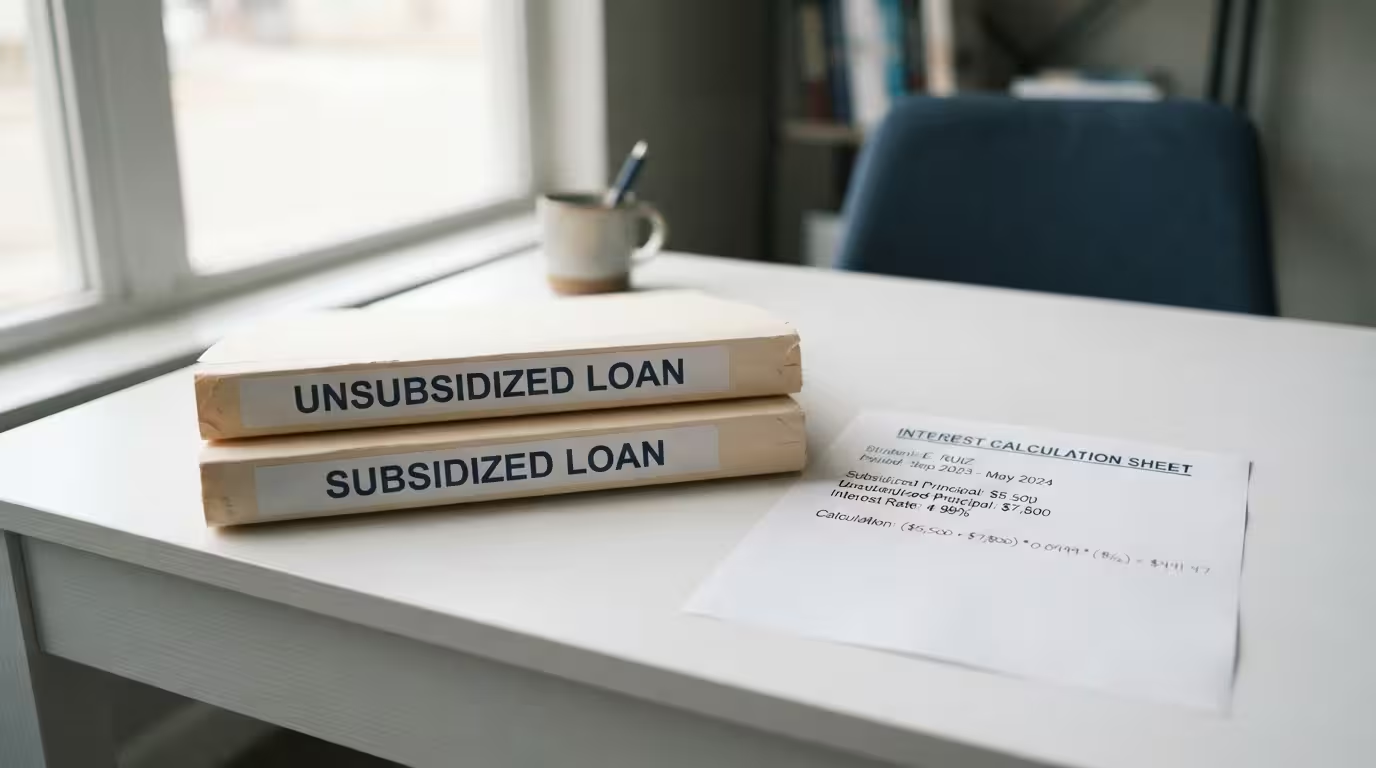
- If you have only Direct Subsidized Loans: The federal government covers your interest during deferment. Taking the full deferment period costs you nothing extra in interest. Use it.
- If you have Direct Unsubsidized Loans: Interest accrues daily. When the deferment period ends, any unpaid interest is added to your principal balance through a process called capitalization. Even small voluntary interest payments during deferment can prevent this from raising your total debt.
- If you have a mix of both: Direct any extra payments toward the unsubsidized balance first, since that is the only balance growing during the pause.
- If you have private loans: Contact your servicer. Interest almost always accrues on private loans during deferment, and capitalization terms vary by contract.
Does Deferment Count Toward Loan Forgiveness?
This is the question most articles skip, and it matters more than almost anything else about deferment.
For Public Service Loan Forgiveness (PSLF), you must make 120 qualifying monthly payments while working full-time for an eligible employer. Months spent in deferment are not qualifying payment months. Deferment time does not count toward your 120-payment total, which means a multi-year deferment can significantly delay when your balance qualifies for forgiveness.
For income-driven repayment (IDR) forgiveness, which cancels remaining balances after 20 or 25 years of qualifying payments, the same principle applies. Deferment months are generally not counted as qualifying payment months for the forgiveness timeline. A borrower who defers for two years extends the time until forgiveness by those same two years.
If you are pursuing forgiveness under either program, an income-driven repayment plan with a payment as low as $0 per month is usually a better choice than deferment. A $0 IDR payment counts as a qualifying payment for both PSLF and IDR forgiveness. Deferment does not. Review your federal repayment plan options before requesting deferment if you are working toward any forgiveness program.
Deferment vs. Forbearance: Key Differences
Deferment and forbearance both pause your required payments, but they are not the same. The most important difference is how interest is handled. From a practical standpoint, choosing the wrong option can cost you more than you expect.
| Deferment | Forbearance | |
|---|---|---|
| Payments paused? | Yes | Yes |
| Interest on subsidized loans | Government covers interest. No accrual | Interest accrues on all loan types |
| Interest on unsubsidized loans | Interest accrues and may capitalize | Interest accrues and may capitalize |
| Requires specific qualifying reason? | Yes, with defined eligibility criteria | Generally more flexible eligibility |
| Counts toward forgiveness timelines? | No | No |
| Best for | Subsidized loan borrowers who meet a qualifying condition | Borrowers who do not meet deferment criteria but need temporary relief |
How to Apply for Student Loan Deferment
Applying for deferment is a straightforward process, but it is not automatic. You must request it through your loan servicer and continue making payments until you receive approval. Starting the process early, before you miss a payment, gives you the most options. If you are still within your grace period, see our guide on what the grace period covers before requesting deferment.
- Log in to StudentAid.gov to identify your federal loan servicer and current loan balances.
- Contact your servicer directly to ask which deferment types you may qualify for based on your situation.
- Complete the appropriate deferment request form. Different deferment types require different forms. Some require documentation such as proof of enrollment, military orders, or proof of public assistance.
- Submit the form and any required documentation to your servicer by mail, upload, or their online portal.
- Continue making payments until you receive written confirmation that your deferment has been approved.
- Track your deferment end date. Set a reminder before the deferment expires so you can choose a repayment plan or request an extension before your first payment is due again.
What If You Don’t Qualify for Deferment?
If you do not meet the eligibility criteria for deferment, forbearance is the next option to explore. Forbearance has more flexible eligibility but does not protect subsidized borrowers from interest accrual. A third option, and often the most underused one, is enrolling in an income-driven repayment plan. IDR plans can set your monthly payment as low as $0 if your income is low enough. Unlike deferment or forbearance, those $0 IDR payments count toward forgiveness timelines. Contact your servicer before missing a payment to discuss which option fits your situation.
For a broader look at how repayment works from the first payment through payoff, our complete student loans guide covers every stage of the process.
FAQ: Student Loan Deferment
Tap any question to expand the answer.
Does student loan deferment hurt my credit score?
An approved deferment does not hurt your credit score. During deferment, your loans are considered current, and no late or missed payments are reported to the credit bureaus. However, you must have your deferment formally approved before the payment due date. If you miss a payment while your deferment request is still being processed, that missed payment can appear on your credit report. Always continue paying until you receive written confirmation of approval.
How long can you defer student loans?
The maximum deferment length depends on the type of deferment. In-school deferment lasts as long as you remain enrolled at least half-time. Unemployment and economic hardship deferments each have a cumulative maximum of 36 months per loan program. Military service deferment covers the period of active duty service plus up to 13 months after. Because deferment time limits are cumulative, it is important to track how many months you have used across all deferment periods combined.
Can I defer private student loans?
Private student loan deferment is not guaranteed. Unlike federal loans, private lenders set their own policies, and some do not offer deferment at all. Those that do may only offer it for specific circumstances such as re-enrollment in school or active military service. If you have private loans and need payment relief, contact your lender directly as early as possible. The terms and any associated fees are spelled out in your loan contract and will differ from federal deferment terms.
Is deferment better than forbearance?
For borrowers with subsidized federal loans, deferment is generally the better option because the federal government covers interest during the deferment period, keeping the loan balance from growing. For borrowers with unsubsidized loans, the difference is smaller since interest accrues during both deferment and forbearance. In either case, both options are generally less advantageous than enrolling in an income-driven repayment plan with a low or $0 monthly payment, since IDR payments count toward forgiveness timelines while deferment and forbearance months do not.
What happens to my student loans if I go back to school during deferment?
If you re-enroll in school at least half-time while you are in an economic hardship or unemployment deferment, your loans may transition to in-school deferment instead. The cumulative time limits on economic hardship and unemployment deferments are separate from in-school deferment, which has no fixed time limit. Contact your loan servicer before re-enrolling to confirm how your deferment type and any remaining eligibility will be handled so you do not accidentally exhaust your deferment time unnecessarily.