By Laurel C. Yazzie | Last reviewed: April 2026
Does Renters Insurance Cover Theft Outside the Home?
Most renters assume their policy only protects belongings inside their apartment. That assumption can be costly. Your renters policy travels with you, but the way it applies outside your home depends on where the theft happens and what was taken.
In reviewing hundreds of policies over a decade in the industry, the detail most renters miss is the off-premises sublimit, a quiet cap that can slash your payout when items are stolen from a storage unit or a second location.
Does renters insurance cover theft outside the home: Yes. Most standard renters insurance policies include off-premises coverage, which protects your personal property against theft whether you are at home, traveling, or running errands. Your full personal property limit generally applies, though some locations, like storage units, may trigger a lower sublimit.
What “Off-Premises Coverage” Actually Means
Renters insurance is built around personal property coverage, and that coverage is not restricted to your four walls. According to the Insurance Information Institute, most renters policies include off-premises coverage, meaning your belongings are protected against the same perils listed in your policy, including theft, even when you are away from home.
Think of it this way: your coverage follows the item, not the address. If your laptop is a covered item under your policy, it stays a covered item whether it is on your kitchen table or in a coffee shop.
Where Your Coverage Follows You
Off-premises coverage typically applies in all of these situations:
- At a hotel, motel, or vacation rental
- In your car, parked on the street or in a lot
- At a gym, library, or workplace
- On public transit or at an airport
- At a college campus or dormitory
- Anywhere in the world while traveling
The coverage limit that applies is your standard personal property limit, the same amount that would apply to a burglary at your apartment, unless one of the exceptions below is triggered.
The Storage Unit and Secondary Residence Exception
This is where many renters are surprised. When your belongings are kept at a storage facility or at a secondary residence (such as a vacation home or a friend’s place where you leave things long-term), your insurer may cap the off-premises reimbursement. The Insurance Information Institute notes that policies commonly limit off-premises coverage to 10 percent of your total personal property limit for belongings stored away from your listed address.
That means if you carry $30,000 in personal property coverage, only $3,000 might apply to items stolen from your storage unit. Check your declarations page for the exact figure in your policy.
From a practical standpoint, renters who store high-value gear in an off-site unit should either increase their personal property limit or add a scheduled personal property endorsement for those items specifically.
Ask yourself two questions:
- Where was the item? If it was with you (on your person, in your bag, in your car, at a hotel), your full personal property limit most likely applies. If it was in a storage unit or left at a secondary address, expect a sublimit.
- What kind of item is it? Standard items like electronics, clothing, and furniture get your full coverage. High-value items like jewelry, watches, or cash have their own sub-limits regardless of location (see the table below).
If both answers point toward a standard item with you personally: you are likely fully covered, minus your deductible. If either answer raises a flag, contact your agent before assuming full coverage.
Does Renters Insurance Cover Theft Outside the Home in These Common Scenarios?
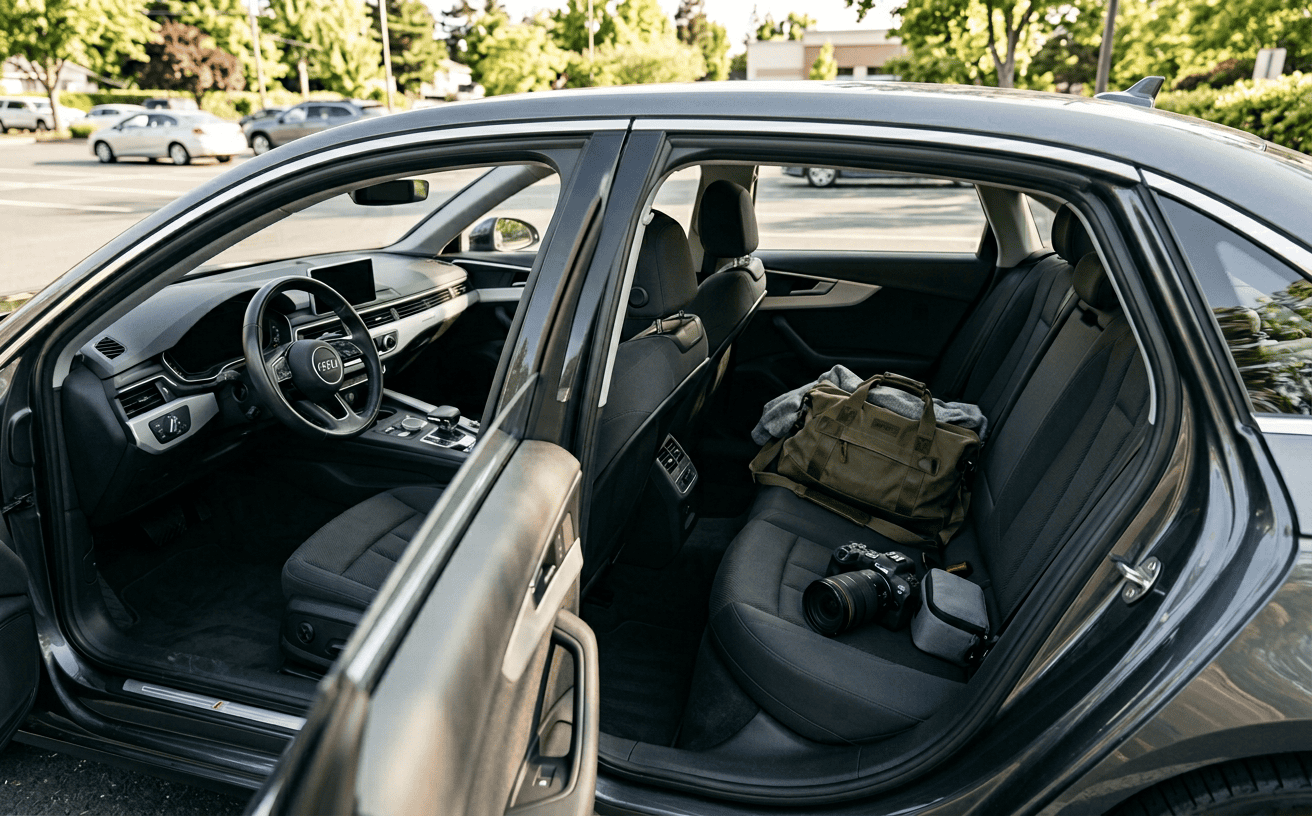
Knowing the rule is one thing. Seeing it applied to real situations is more useful. Here is how off-premises coverage works across the most common theft scenarios renters face.
Items Stolen from Your Car
Your renters policy covers personal belongings stolen from your vehicle, not the vehicle itself. If your bag, laptop, or camera is taken in a car break-in, your renters policy steps in. Your auto insurance handles damage to the car, such as a smashed window, but it does not cover the items inside.
One important note: the item needs to have been inside the car, not the car itself. Vehicle theft is an auto insurance matter only.
Theft While Traveling or on Vacation
Off-premises coverage follows you internationally as well as domestically. A pickpocketed phone in a foreign city or a laptop stolen from a hotel room are both standard covered losses under most renters policies. Coverage applies up to your personal property limit, minus your deductible.
Theft at College or a Dorm
Full-time students living in campus housing may be partially covered under a parent’s renters or homeowners policy, though that coverage is typically capped at 10 percent of the parent’s personal property limit. Students in off-campus apartments generally need their own renters policy to be fully protected. The National Association of Insurance Commissioners recommends that students confirm coverage details with their parents’ insurer before assuming they are protected.
Items With Special Sub-Limits You Need to Know About
What most people miss when reading their policy is the schedule of sub-limits buried in the personal property section. Even with a $30,000 personal property limit, certain categories of items are capped at much lower amounts, inside or outside the home.
| Item Category | Common Limit Range (verify your policy) | How to Get Full Coverage |
|---|---|---|
| Jewelry and watches | Typically lower than your main limit — check your declarations page | Schedule items with an endorsement or floater |
| Cash and currency | Often under $300 | Cannot typically be scheduled; keep cash at home |
| Firearms | Commonly $1,500–$2,500 | Schedule individually or add a separate firearms policy |
| Musical instruments | Varies widely by policy | Add a personal articles floater |
| Electronics (laptops, phones) | Usually covered at full limit | Confirm replacement cost vs. ACV in your policy |
Sub-limits vary by insurer and by state. Always confirm the exact figures on your declarations page rather than assuming any standard applies to your specific policy.
Actual Cash Value vs. Replacement Cost: Why It Matters After a Theft
Even when a theft is fully covered, the payout you receive depends on how your policy values items. This is one of the most important choices in your policy, and it matters most at claim time.
- Actual Cash Value (ACV): The insurer pays what the item is worth today, after depreciation. A laptop purchased for $1,200 three years ago might pay out only a few hundred dollars.
- Replacement Cost Value (RCV): The insurer pays what it costs to buy a comparable new item. That same laptop would pay out close to the current retail price of a replacement.
RCV policies carry a slightly higher premium, but the difference in a theft payout can be significant. For renters who carry high-value electronics or frequently travel with equipment, the added cost is often worth it.
How to File a Theft Claim on Your Renters Policy
Filing a claim correctly and promptly protects your right to reimbursement. In practice, many renters delay reporting because they are unsure whether the loss meets the deductible threshold. Report first, calculate later. Insurers can close a claim if it is not filed within the time window stated in your policy.
What to Do in the First 24 Hours
Acting quickly after a theft makes the claims process smoother. Follow these steps in order:
- File a police report. This is required by most insurers. Get the report number and the officer’s name.
- Document the loss. Make a list of all stolen items, including make, model, serial number, and estimated value. Gather receipts, photos, or bank statements that establish what you owned.
- Notify your insurer promptly. Contact your insurance company the same day if possible. Some policies require notification within 48 to 72 hours.
- Avoid disposing of anything. Do not throw away damaged property until a claims adjuster has reviewed your claim.
- Submit a proof of loss form. Your insurer will send this after you open the claim. Return it within the deadline stated in your policy.
For more on how personal property limits and the claims process work together, see our guide to understanding renters insurance personal property coverage.
How to Make Sure You Have Enough Coverage
The most common coverage gap is not a missing policy. It is a personal property limit set too low. A renter who carries $15,000 in coverage but owns $35,000 worth of belongings will be underinsured the moment a serious theft occurs.
- Create a home inventory before something goes wrong. List every item of value with its estimated replacement cost.
- Review your sub-limits for jewelry, electronics, and other high-value categories against what you actually own.
- If you travel frequently with expensive gear, consider a personal articles floater for those items specifically.
- Review your deductible. A higher deductible lowers your premium but means more out of pocket when a small theft occurs.
For a broader look at what your policy covers beyond theft, including liability and loss-of-use benefits, see our overview of what renters insurance covers. If you are also comparing renters coverage to other protection options, our article on renters insurance vs. homeowners insurance breaks down the key differences.
FAQ: Does Renters Insurance Cover Theft Outside the Home?
Does renters insurance cover items stolen from my car?
Yes. Renters insurance covers personal belongings stolen from inside your vehicle. If your laptop, bag, or camera is taken in a break-in, your personal property coverage applies up to your policy limit minus your deductible. Your auto insurance covers damage to the car itself, such as a broken window, but it does not cover the contents. Keep your deductible in mind before filing: if the stolen items are worth less than your deductible, a claim may not be financially worthwhile.
Is there a limit on what renters insurance pays for off-premises theft?
For most locations, your full personal property limit applies. However, when items are stored at a storage facility or left at a secondary residence, many policies cap the payout at 10 percent of your total personal property coverage. Additionally, certain item categories, including jewelry, cash, and firearms, carry their own lower sub-limits regardless of where the theft occurs. Check your declarations page to see the exact figures for your specific policy.
What happens if my phone or laptop is stolen while I am traveling internationally?
Most standard renters policies extend off-premises coverage worldwide, meaning a theft in another country is treated the same as a theft in your city. You would still need to file a local police report where the theft occurred and provide documentation of the item’s value. The payout will reflect your policy’s valuation method: if you have actual cash value coverage, depreciation will be applied; replacement cost coverage would pay closer to the current retail price of a comparable new item.
Does renters insurance cover theft if my door was unlocked or I was careless?
In most cases, yes. Renters policies generally do not require you to prove you locked your door or secured your belongings for a theft claim to be valid. However, if an insurer determines that an item was essentially handed over or left unattended in a grossly negligent way, they may contest the claim. The standard is theft, meaning someone took property without your consent. Leaving a bag unattended at a gym or a laptop on a cafe table while you stepped away would typically still qualify as theft, not negligence, under most policy definitions.
Does renters insurance cover bicycle theft outside my home?
Yes. Bicycle theft is covered under the personal property section of most renters policies, whether the bike is stolen from inside your apartment, from a bike rack outside your building, or from a rack at a park or workplace. Because bicycles are not motor vehicles, they fall under renters insurance rather than auto insurance. High-value bikes may benefit from a scheduled personal property endorsement to ensure you receive the full replacement cost rather than a depreciated actual cash value payout.