Paycheck Advance vs Payday Loan: What Is the Real Difference?
By Laurel C. Yazzie | Last reviewed: August 2026
When a bill hits before payday, two options often come up: a paycheck advance and a payday loan. The phrases sound alike, but a paycheck advance vs payday loan comparison reveals a dramatic gap in cost and risk. One lets you access wages you have already earned, usually at little or no charge. The other is a high-cost loan from a third-party lender that can trigger a cycle of fees. Understanding the difference can save a borrower hundreds of dollars.
In reviewing hundreds of loan applications over a decade in consumer lending, the detail most borrowers miss is this: a paycheck advance is not a loan at all. You are accessing pay you have already earned. A payday loan is new debt, and it comes with a price that few people see clearly before they sign.
What Is a Paycheck Advance?
A paycheck advance gives you early access to wages you have already earned but have not yet received. In most cases your employer provides the advance directly and deducts the amount from your next paycheck. There is no outside lender, and in many situations there is no interest and no credit check.
Advances come in three common forms:
- Employer direct advance: You request an advance through HR or payroll. The company advances part of your earned wages, then recovers the amount from the next paycheck. Many employers charge nothing; some charge a small processing fee.
- Earned wage access (EWA) app: Third-party platforms such as DailyPay or Payactiv integrate with your employer’s payroll system and release a portion of earned wages on demand. Costs vary: some apps charge a flat instant-transfer fee, others use a subscription model.
- Early direct deposit: Some banks and credit unions release your paycheck up to two business days early at no charge when you have direct deposit set up. This is not a loan and carries no fee at all.
What Does a Paycheck Advance Actually Cost?
The cost of a paycheck advance depends on the source. Employer-direct advances are frequently free or carry a flat administrative fee under $10. EWA apps may charge a flat instant-transfer fee or a low monthly subscription. Early direct deposit through a bank is generally free. In every case, the cost is a fraction of what a payday lender charges for a comparable amount.
Because you are accessing wages you have already earned, the concept of an annual percentage rate does not apply in the traditional sense. You are not borrowing new money. You are simply receiving it early.
What Is a Payday Loan?
A payday loan is a short-term, high-cost loan from a storefront or online lender, usually for $500 or less. According to the Consumer Financial Protection Bureau, payday loans typically charge $10 to $30 for every $100 borrowed and are due in full on your next payday, usually within two to four weeks.
A typical two-week payday loan with a $15-per-$100 fee carries an annual percentage rate (APR) of nearly 400 percent, according to the CFPB. The Federal Reserve’s G.19 consumer credit release publishes current average rates for credit cards and other consumer products — the gap between those figures and a payday loan APR is significant.
Key features of payday loans:
- Loan amounts typically $500 or less
- Repayment due in full by your next payday, usually within 14 to 30 days
- Fees that equal an APR of nearly 400% for a typical two-week loan (CFPB)
- Rarely require a credit check, making them easy to get but easy to misuse
- High rollover risk if you cannot repay on time
How Quickly Payday Loan Costs Grow
What most people miss when comparing loan offers is how fast rollover fees accumulate. If you cannot repay a $300 payday loan on its due date, many lenders allow you to roll the loan over by paying only the fee. On a $300 loan with a $15-per-$100 fee structure, each rollover costs $45 and does not reduce the principal by a single dollar. According to the CFPB, many payday borrowers continue to pay significant rollover fees despite state-level protections. To understand how that fee cycle builds, see our explainer on how payday loan fees are calculated.
Paycheck Advance vs Payday Loan: Key Differences
The comparison comes down to four factors: who provides the money, what it costs, how repayment works, and what happens to your credit. The table below lays them out side by side. Fee ranges for payday loans are drawn from CFPB guidance.
| Factor | Paycheck Advance | Payday Loan |
|---|---|---|
| Source of funds | Your employer or a payroll-linked app | A third-party lender |
| What you receive | Wages you have already earned | A loan against your future paycheck |
| Typical cost | Free to a small flat fee | $10–$30 per $100 borrowed (CFPB) |
| APR equivalent | Near zero in most cases | Nearly 400% for a two-week loan (CFPB) |
| Repayment method | Deducted from your next paycheck automatically | Lump sum due on or before your next payday |
| Credit check | Rarely required | Rarely required |
| Impact on credit | No impact | Generally none, but unpaid balances can lead to collections |
| Rollover risk | None | High if unpaid on the due date |
In practice, many borrowers do not realize that the repayment structure is where the real risk lives. A paycheck advance is deducted automatically from your next paycheck. You cannot forget to pay it, and there is no fee for being late because there is no lender waiting. A payday loan requires you to have the full balance available on a specific date, and missing that date can trigger rollover fees that extend the debt for weeks.
Which Option Should You Choose?
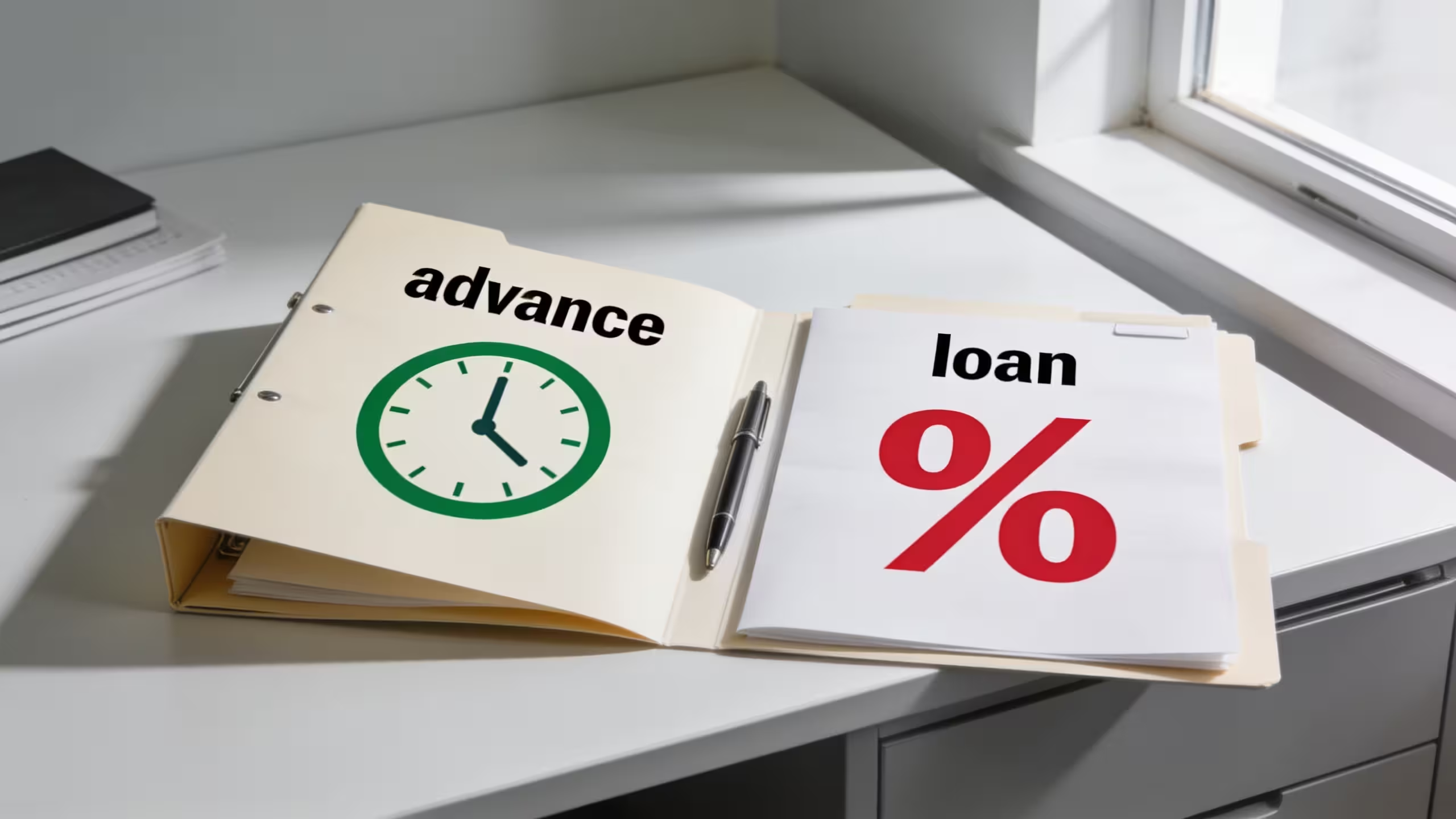
The right choice depends on what is available to you. Use this four-step framework in order:
- Does your employer offer paycheck advances or an EWA app? Start here. This is almost always the lowest-cost option, and the repayment is handled automatically.
- Can you wait a day or two? If your bank offers early direct deposit, your paycheck may already be available before your official pay date. Check your account before doing anything else.
- Are you a credit union member? Federal credit unions participating in the National Credit Union Administration’s program can offer Payday Alternative Loans (PALs) with interest rates capped at 28% APR, far below what payday lenders charge. Find participating credit unions through MyCreditUnion.gov.
- If none of the above applies: A payday loan may be the only option immediately available. Use it only if you are certain you can repay the full amount, including fees, on the due date without borrowing again. If you cannot, the cost grows fast.
If you find yourself at Step 4 more than once in a few months, the pattern itself is the problem. A short-term loan cannot close a recurring gap between income and expenses. For options that address the underlying issue, see our roundup of lower-cost payday loan alternatives.
What to Do When Your Employer Has No Advance Program
Not every employer offers paycheck advances, and not every financial emergency can wait. If your employer has no program and you need cash before payday, here are the next best steps before turning to a payday lender.
First, check whether any credit union near you participates in the PAL program. The NCUA caps PAL rates at 28% APR, you must be a member for at least one month to qualify, and the maximum loan amount under the standard PAL program is $1,000. The income-verification requirement is straightforward. This is a legitimate, regulated alternative that exists specifically because regulators recognized how expensive payday loans are.
Second, contact your state or local government social services office. Many states and municipalities offer emergency assistance programs for utility bills, rent, and other pressing expenses that payday loans are commonly used for. These programs are not well advertised but are often available.
For a full overview of every payday loan-related topic covered on this site, visit our payday loans guide.
Compare Your Options at a Glance
Click any row to highlight it. APR data sourced from the CFPB and NCUA.
| Feature | Employer Advance | EWA App | Credit Union PAL | Payday Loan |
|---|---|---|---|---|
| Typical APR | ~0% | Low flat fee | Up to 28% APR | ~400% APR |
| Credit check | No | No | Flexible | No |
| Repayment | Auto payroll deduction | Auto on payday | Installments (1–12 months) | Lump sum, next payday |
| Rollover risk | None | None | None (prohibited by NCUA) | High |
| Availability | If employer offers it | If employer is integrated | Must be CU member 1+ month | Widely available |
| Debt cycle risk | Very low | Very low | Low | High |
APR for payday loans: Consumer Financial Protection Bureau. PAL APR cap: NCUA / MyCreditUnion.gov. Click any row to highlight.