Best Student Loans for Online College: Federal and Private Options Compared
By Laurel C. Yazzie | Last reviewed: November 2026
If you are enrolled at an accredited online college, the best student loans for online college are the same federal and private options available to campus students. The difference is knowing which ones you qualify for, in what order to apply, and when private lenders make sense as a supplement. This guide walks you through both paths side by side, with specific attention to the eligibility rules that catch online students off guard.
Having worked directly with clients on loan applications for distance and online degree programs, the most common mistake I saw was borrowers skipping the FAFSA entirely because they assumed an online school would not qualify for federal aid. In most cases, that assumption was wrong, and it cost them access to loans with far better terms.
Do Online College Students Qualify for Federal Student Loans?
Yes. Online students at accredited schools can access federal student loans under the same rules as students attending in person. Two conditions determine your eligibility: your school must hold the right accreditation, and you must meet a minimum enrollment status.
- Your school must be accredited by an agency recognized by the U.S. Department of Education and be eligible for Title IV federal student aid.
- You must be enrolled at least half-time to qualify for most federal student loans. The specific credit-hour threshold that counts as “half-time” is set by your school.
- You must complete the FAFSA (Free Application for Federal Student Aid) each academic year. No federal student loan is available without it.
- You must be a U.S. citizen or eligible non-citizen with a valid Social Security number.
- You must maintain satisfactory academic progress as defined by your institution’s policies.
According to the Consumer Financial Protection Bureau, completing the FAFSA is the single most important first step for any student exploring their aid options. Many students leave federal grants, which never need to be repaid, on the table simply by not filing.
Federal Loan Types for Online College Students
Federal loans come from the U.S. government and carry fixed interest rates set annually by Congress. They offer income-driven repayment plans, deferment protections, and potential loan forgiveness programs that private lenders generally do not.
In reviewing hundreds of loan applications over a decade in consumer lending, the detail most borrowers miss is the difference between subsidized and unsubsidized loans. With subsidized loans, the federal government covers the interest while you are enrolled at least half-time, which significantly lowers your total repayment cost compared to letting that interest compound from day one.
For a closer look at how these two types differ, see our guide on types of federal student loans.
| Loan Type | Who Qualifies | Rate Type | Income-Driven Repayment | Min. Enrollment |
|---|---|---|---|---|
| Direct Subsidized Loan | Undergrads with demonstrated financial need | Fixed | Yes | Half-time |
| Direct Unsubsidized Loan | Undergrads and graduate students (no need requirement) | Fixed | Yes | Half-time |
| Grad PLUS Loan | Graduate and professional students | Fixed | Yes | Half-time |
| Parent PLUS Loan | Parents of dependent undergraduate students | Fixed | Limited (ICR only) | Half-time (student) |
What If You Are Enrolled Less Than Half-Time?
If your online program drops below half-time for a given term, you will not qualify for Direct Subsidized or Unsubsidized Loans in most cases. Some schools certify students at a half-time equivalent even when they take fewer credit hours in a particular term, but that determination belongs entirely to your institution’s financial aid office. If you are completing a certificate or non-degree program, your options depend on whether that program holds Title IV eligibility. Contact your school’s financial aid office directly before counting on federal loans to cover a term in which you are less than half-time.
Best Student Loans for Online College: Private Lenders Worth Comparing
Private student loans come from banks, credit unions, and online lenders. They can help cover costs that federal loans do not, including tuition gaps and in some cases housing and living expenses. They typically carry fewer borrower protections, and your interest rate depends largely on your credit history or that of a cosigner.
What most people miss when comparing loan offers is that private student loan rates and terms vary considerably from one lender to the next. Lenders set their own minimum credit score requirements, which they rarely publish publicly. Checking your rate with multiple lenders through a soft-pull prequalification will not affect your credit score.
Decision Framework: Federal First, Private Second
If you are enrolled at least half-time at an accredited, Title IV-eligible school: complete the FAFSA first. Exhaust your federal loan eligibility before considering any private option. Federal loans come with income-driven repayment plans, deferment protections, and potential forgiveness that private loans do not.
If your federal loans do not cover your full cost of attendance: explore private loans as a supplement only after you have maximized your federal aid.
If you are enrolled less than half-time, or your school is not Title IV-eligible: private student loans may be your only financed option. Compare APRs carefully across multiple lenders before committing.
If you have no credit history and no cosigner: look specifically for lenders that offer no-cosigner student loan programs before applying to standard private lenders, where a denial can still trigger a hard inquiry.
When reviewing private lenders, compare these factors across each option:
- Fixed vs. variable interest rate options and which works better for your expected repayment timeline
- Cosigner requirements and whether the lender offers cosigner release after a set number of on-time payments
- In-school deferment vs. immediate repayment requirements
- Grace period length after leaving school or graduating
- Autopay discount availability and how much it reduces your rate
- Whether the lender certifies loans for your specific school and program
Comparing Federal vs. Private Loans for Online Students
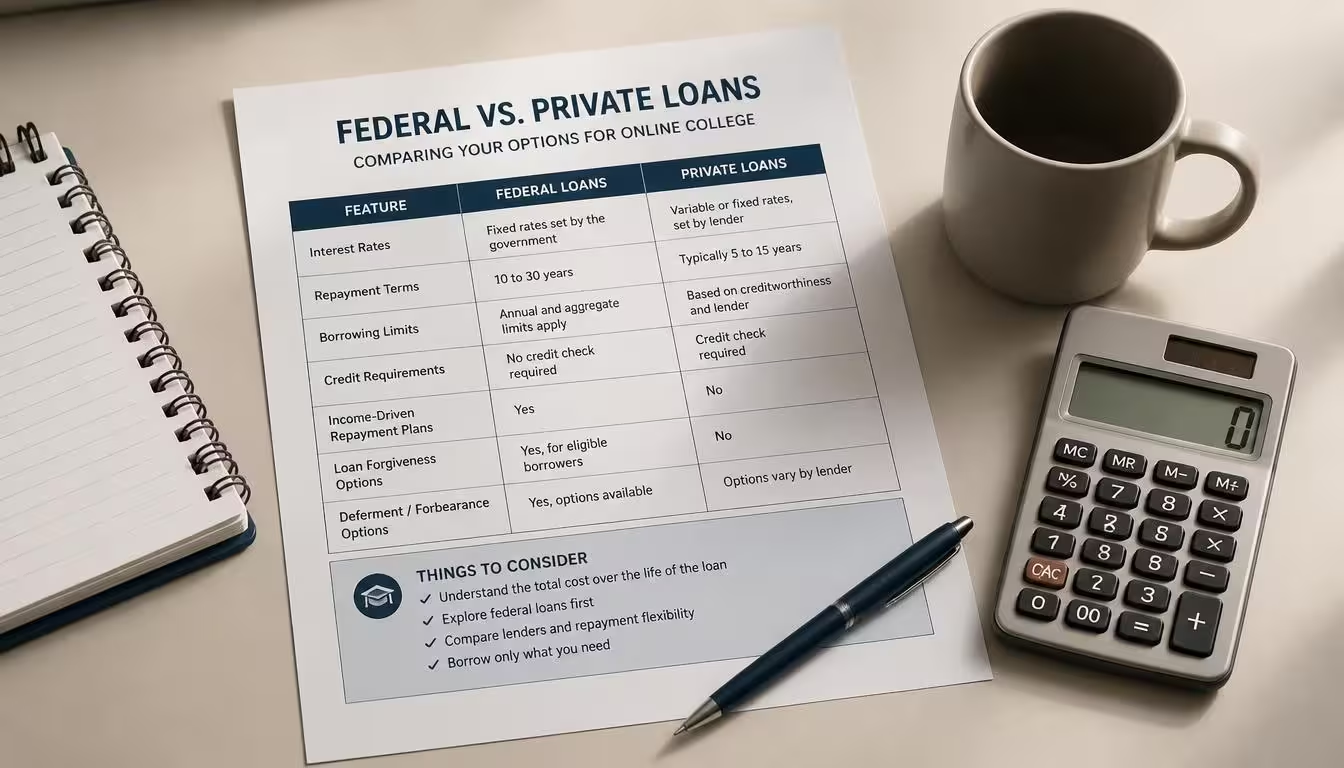
The table below places federal and private student loans side by side across the factors that matter most to online college students. The right-hand column, which competitors consistently omit, translates each difference into what it actually means for someone in an online program.
| Feature | Federal Student Loans | Private Student Loans | What It Means for Online Students |
|---|---|---|---|
| FAFSA required | Yes | No | Always file the FAFSA first, even if you plan to borrow privately. It may unlock grants you do not repay. |
| Credit check required | No (except PLUS loans) | Yes (most lenders) | Federal loans are accessible regardless of credit history. No credit score threshold to meet. |
| Income-driven repayment | Yes | Rarely | Critical for online graduates entering lower-income fields where loan payments could otherwise be unmanageable. |
| Loan forgiveness eligible | Yes | No | Federal loans qualify for Public Service Loan Forgiveness. Private loans do not, regardless of your career. |
| Available if less than half-time | No (in most cases) | Varies by lender | Part-time online students below the half-time threshold often have private loans as their only financed option. |
| School accreditation required | Yes (Title IV eligibility) | Yes (most lenders) | Verify your online school’s accreditation before applying. Neither loan type is available at unaccredited schools. |
| In-school deferment | Yes (automatic) | Varies by lender | Confirm in-school deferment terms with any private lender before signing. Some require immediate payments. |
For a full breakdown of the differences between these two categories, see our guide on how federal and private loans compare.
How to Apply for Student Loans for an Online College
From a practical standpoint, most loan regret among online students traces back to skipping step one or jumping to private lenders before confirming federal eligibility.
- Verify your school’s accreditation status. Confirm that your online college holds accreditation recognized by the U.S. Department of Education and that it participates in Title IV federal aid programs. Schools eligible for federal aid are listed in the federal student aid database at StudentAid.gov.
- Complete the FAFSA. The form opens each October for the following academic year. File as early as your financial documents allow, as some aid programs award funds on a first-come basis.
- Review your financial aid award letter. After your school processes your FAFSA, it will send a financial aid offer. Accept federal grants first, then subsidized loans, then unsubsidized loans. Each has a different long-term cost.
- Calculate your remaining funding gap. Subtract your total federal aid from your certified cost of attendance. The result is the maximum amount you should consider borrowing through private loans.
- Compare private lenders using soft-pull prequalification. Most private lenders allow you to check estimated rates and terms without triggering a hard credit inquiry. Use at least two or three lenders to compare offers before choosing.
- Apply and await school certification. Private lenders require your school to certify the loan amount, confirming it does not exceed your cost of attendance. This step adds time, so do not wait until the last moment before your enrollment deadline.
According to USA.gov, understanding your full range of financial aid options before borrowing is one of the most important steps a student can take to minimize long-term debt. Funding timelines vary by lender: ask about expected disbursement timing before you apply.
Common Mistakes Online College Students Make When Borrowing
Most loan regret comes from avoidable errors made before or at the point of application.
- Skipping the FAFSA because they assumed they would not qualify. Federal Pell Grants, subsidized loans, and other non-repayable aid require the FAFSA. Many students who assumed they would not qualify were wrong.
- Borrowing the maximum amount offered rather than the minimum needed. Every dollar borrowed is a dollar plus interest you repay later. Only borrow what your documented cost of attendance requires for the current term.
- Choosing an online school without confirming its Title IV status. If a school loses its accreditation while you are enrolled, federal loan deferment protections may be affected. Verify before you enroll, not after.
- Not comparing private lenders. Two lenders offering the same loan amount can have meaningfully different APRs, fee structures, and deferment terms. Soft-pull rate shopping costs nothing and takes minutes.
- Ignoring interest accumulation while in school. Unsubsidized and private loans accrue interest from disbursement, not from graduation. Even small monthly payments during enrollment reduce your total repayment balance.
For a comprehensive overview of everything to consider before taking on student debt, visit our student loan borrowing resources hub.
Which Student Loan Should I Apply For?
Answer 3 questions to find out where to start.
1. Is your online college accredited and eligible for federal student aid (Title IV)?