By Laurel C. Yazzie | Last reviewed: May 2026
Renters Insurance Coverage Limits Explained
Understanding renters insurance coverage limits is one of the most important steps before choosing a policy. Most renters skip this part and only discover gaps when they file a claim. This guide walks through each coverage type, shows how sub-limits work in practice, and gives you a clear framework for setting amounts that actually protect you.
Renters Insurance Coverage Limits Explained: A coverage limit is the maximum your renters insurance policy will pay for a single claim or loss type. Every policy has separate limits for personal property, liability, and additional living expenses. Sub-limits also apply to specific categories like jewelry, capping payouts even when your overall limit is higher.
What Is a Renters Insurance Coverage Limit?
A coverage limit is the ceiling your insurer sets on each part of your policy. Once a claim reaches that ceiling, you pay the rest out of pocket. You choose most of these limits when you buy, and you can usually adjust them at renewal or mid-term.
In practice, many renters assume that any loss will be fully reimbursed up to whatever they paid in premiums. That is not how it works. Coverage applies only up to the limit for each category. Knowing where those limits sit before you file is what separates a useful policy from a costly lesson.
- Personal property limit: The most your insurer pays to repair or replace your belongings after a covered event such as fire or theft.
- Liability limit: The most your insurer pays for injury or property damage claims made against you.
- Additional living expenses (ALE) limit: The most your insurer covers for temporary housing and meals while your unit is being repaired.
- Medical payments limit: A smaller amount that pays a guest’s medical bills if they are injured on your property, without a lawsuit.
Overall Limit vs. Sub-Limit: What’s the Difference?
Your overall personal property limit is the total your insurer will pay for all belongings combined in a single claim. A sub-limit is a lower cap that applies to one specific category of item, regardless of your overall total.
Here is how the gap shows up: your policy may carry a $30,000 personal property limit, but jewelry may have a separate sub-limit. According to the Insurance Information Institute, standard renters policies typically cover jewelry up to around $1,500 for theft or other listed perils. If a thief takes $6,000 in jewelry, you receive $1,500. The other $4,500 is your loss, even though your overall limit was never reached. If your pieces are worth more, a scheduled personal property endorsement can cover them at full appraised value.
The Four Main Coverage Types and Their Limits
Each section of your renters policy operates independently. Here is what each one pays and where the limits typically begin.
Personal Property Coverage
This is the section that pays to repair or replace your belongings after fire, theft, vandalism, or other covered events. You set this limit yourself, so accuracy depends on how well you know the value of what you own. A room-by-room home inventory is the most reliable way to pick the right number.
One detail that surprises many policyholders: the off-premises sub-limit. According to the Insurance Information Institute, off-premises coverage is generally limited to around 10 percent of your total personal property limit. A $25,000 policy may cover only $2,500 for property stolen from your car or lost while traveling.
Liability Coverage
Liability pays your legal defense costs and any settlement if someone is injured in your rental or you accidentally damage another person’s property. According to the Insurance Information Institute, liability limits generally start at $100,000, and some insurance professionals recommend purchasing at least $300,000.
In reviewing hundreds of policies over a decade in the industry, the detail most renters miss is that liability limits should reflect net worth, not just the value of belongings. A court judgment that exceeds your limit can reach savings, wages, and future income.
Additional Living Expenses (ALE)
If a covered event forces you out of your rental, ALE covers temporary housing, hotel stays, and additional meal costs while your unit is being repaired. Most policies cap ALE at both a dollar amount and a time limit. Check your declarations page for the specific figures on your policy.
Medical Payments to Others
This small but practical coverage pays a guest’s medical bills if they are injured at your home, without requiring a fault determination or lawsuit. According to the Insurance Information Institute, you can generally get between $1,000 and $5,000 of this coverage.
| Coverage Type | What It Pays | Typical Starting Point |
|---|---|---|
| Personal Property | Repair or replace belongings | You choose at purchase |
| Liability | Legal costs and settlements | Commonly $100,000 minimum |
| Additional Living Expenses | Temporary housing and meals | Set by insurer — check policy |
| Medical Payments | Guest’s medical bills (no-fault) | Typically $1,000 to $5,000 |
Renters Insurance Coverage Limits Explained: Sub-Limits on High-Value Items
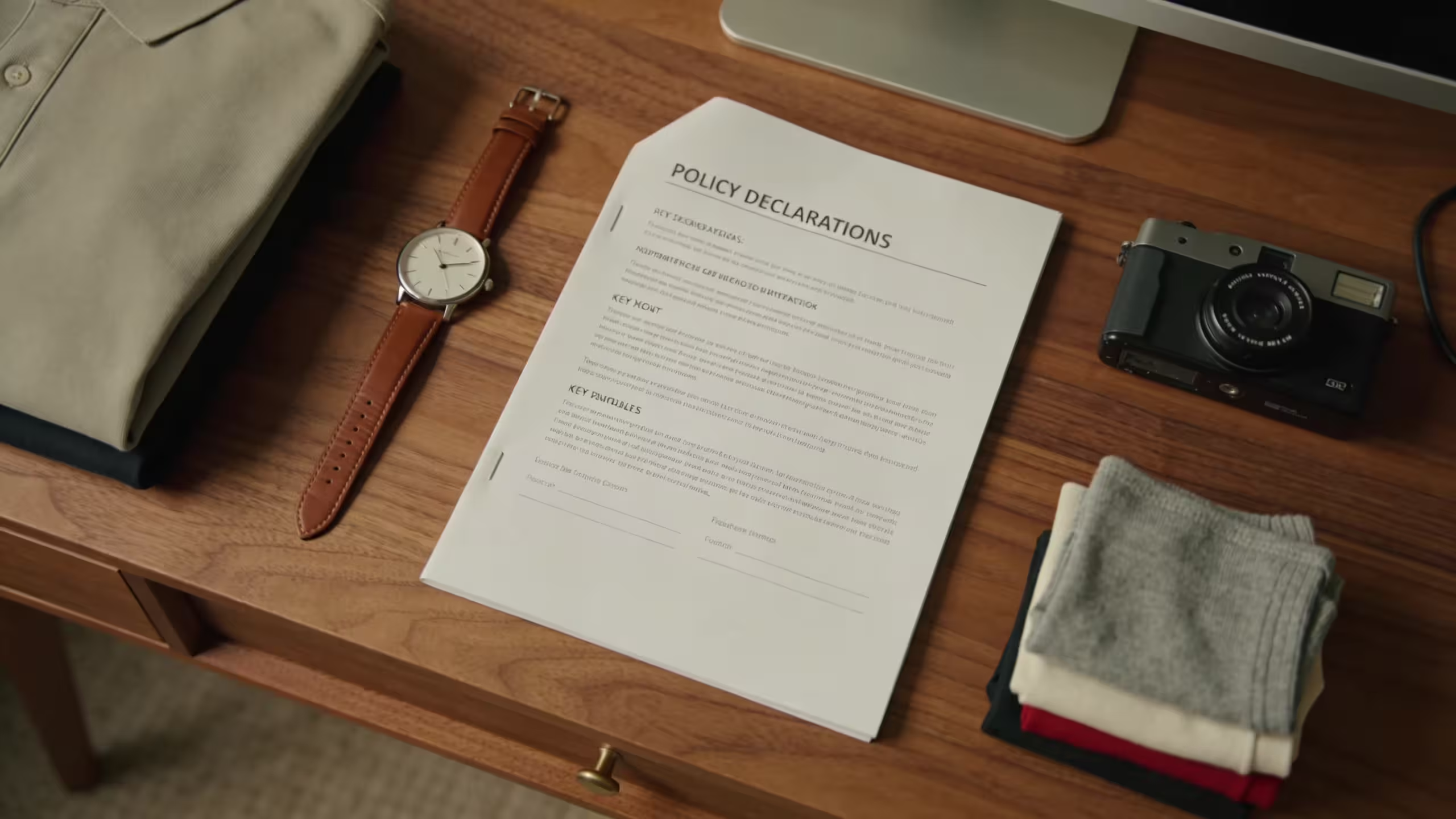
Sub-limits are the part of your policy most likely to create a gap at claim time. They apply to categories of property that are high-value, portable, or frequently stolen, and they cap your payout for those items well below your overall limit.
Common categories that carry sub-limits in standard policies include jewelry, fine art, musical instruments, collectibles, silverware, and firearms. The exact caps vary by insurer and state. Always review your declarations page when your policy arrives, and if an item is worth more than the sub-limit shown, ask your insurer about scheduling it separately for its full appraised value.
What Happens When Your Belongings Exceed the Sub-Limit?
When a claimed item exceeds its sub-limit, you absorb the difference. Your insurer pays only up to the cap for that category, even if your overall personal property limit has not been reached. The two limits are independent.
Consider a renter in their late 20s who owns a high-end guitar collection worth $12,000. A fire destroys the instruments. If the policy carries a low sub-limit on musical instruments, the payout may cover only a fraction of the loss. The renter’s $40,000 overall personal property limit does not change the outcome because the sub-limit governs that specific category.
The fix is straightforward once you know the two limits are independent. The fix is straightforward: take inventory of any item that could fall under a category sub-limit, compare its value to the cap on your declarations page, and ask your insurer about a floater or endorsement if the gap is significant.
Actual Cash Value vs. Replacement Cost: How Your Limit Works in Practice
Your coverage limit is the ceiling. How your insurer calculates the payout within that ceiling is just as important.
- Actual Cash Value (ACV): Pays the current depreciated value of a damaged or stolen item. A laptop purchased three years ago for $1,200 might yield a few hundred dollars after depreciation is applied.
- Replacement Cost Value (RCV): Pays what it costs to buy a comparable new item at today’s prices. That same laptop would be reimbursed closer to its current retail value.
According to the Insurance Information Institute, replacement cost coverage runs about 10 percent more in premium. For renters with newer electronics, furniture, or appliances, that difference is almost always worth it. ACV policies can leave you significantly short even when a claim stays well inside your coverage limit.
How to Choose the Right Coverage Limits for Your Situation
When reviewing policies, the question is not only how much coverage you can afford but how much you actually need. Here is a simple framework for each decision.
Coverage Limit Decision Framework
- Personal property: If your home inventory total exceeds your current limit, raise it. If you have not done an inventory, do one before your next renewal.
- Liability: If your net worth (savings, retirement accounts, and future earnings) exceeds $100,000, consider $300,000 or more. If you own pets, host frequent visitors, or have teenagers in the household, lean toward the higher end.
- ALE: Think about what one to two months of temporary housing in your area would cost. If your policy cap falls short, ask about increasing it.
- High-value items: If any single item is worth more than its category sub-limit, schedule it separately on your policy.
How Do I Know If My Limits Are High Enough?
A home inventory is the most reliable starting point for personal property. Once you have a replacement-cost total for your belongings, you can compare it directly to your policy limit and close any gap before a claim occurs. For a full walkthrough, see our guide on how much renters insurance you need. If you are still building your understanding of what each protection type actually covers, our overview of what renters insurance covers covers the basics in plain language.
From a practical standpoint, the two most underinsured areas in a typical renters policy are liability and high-value items subject to sub-limits. It is also worth reviewing your renters insurance deductible alongside your limits: a high deductible reduces the value of adequate limits on smaller claims.
FAQ: Renters Insurance Coverage Limits
What is the difference between a coverage limit and a sub-limit in renters insurance?
A coverage limit is the maximum your insurer will pay for an entire category of loss, such as all personal belongings combined. A sub-limit is a lower cap that applies only to a specific type of item within that category, such as jewelry or musical instruments. Even if your overall personal property limit is $40,000, a jewelry sub-limit of $1,500 means you receive at most $1,500 for any jewelry claim, regardless of actual loss. To protect high-value items above their sub-limit, you can add a scheduled personal property endorsement.
Does renters insurance cover my belongings outside my apartment?
Yes, most renters policies include off-premises coverage, meaning your belongings are protected against covered perils even when they are away from your home. However, the Insurance Information Institute notes that off-premises coverage is generally limited to around 10 percent of your total personal property limit. So if your policy limit is $25,000, you may only be covered for up to $2,500 for property stolen from your car or lost while traveling. Check your declarations page for the specific sub-limit that applies to your policy.
Should I choose actual cash value or replacement cost coverage?
Replacement cost coverage pays what it would cost to buy a comparable new item today, while actual cash value pays the depreciated worth of the item at the time of loss. For most renters, replacement cost coverage is the better choice because it closes the gap between what a used item is worth and what it actually costs to replace. According to the Insurance Information Institute, replacement cost coverage typically runs about 10 percent more in premium, which is usually a small amount relative to the higher payouts it delivers.
How much liability coverage do renters actually need?
Liability limits in renters policies generally start at $100,000, according to the Insurance Information Institute. Some insurance professionals recommend at least $300,000, particularly for renters who own pets, host guests regularly, or have a net worth above $100,000. If a court judgment exceeds your liability limit, the difference can be satisfied from your savings, wages, and future income. For renters who want a higher level of protection beyond standard limits, a personal umbrella policy can extend coverage significantly at a relatively low annual cost.
What is a scheduled personal property endorsement and when do I need one?
A scheduled personal property endorsement, sometimes called a floater, insures a specific item at its full appraised or agreed value rather than subject to the standard sub-limit in your policy. You need one when a single item, such as an engagement ring, a musical instrument, or fine art, is worth more than the sub-limit shown on your declarations page for that category. Most endorsements require a recent appraisal or receipt. The premium increase is typically small relative to the added coverage, and some endorsements also cover risks like accidental loss or breakage that a standard policy excludes.
Back to the complete renters insurance guide library.